

Updated August 2026.
This article contains affiliate links. We may earn a commission at no additional cost to you if you make a purchase through these links. See our affiliate disclosure for details.
Measuring your luggage correctly takes about 30 seconds and saves you from the $50-$100 surprise at the gate when the airline agent decides your bag is too big. The rules are straightforward, but the way manufacturers report dimensions versus how airlines measure them creates confusion that costs travelers real money.
Here’s exactly how to measure a suitcase the way airlines do, what the numbers mean, and why the dimensions on the product listing might not match what the gate agent’s sizer box says.
How to Measure a Suitcase
You need three measurements: height (top to bottom), width (side to side), and depth (front to back). Stand the suitcase upright as if you’re about to roll it. Measure from the highest point to the floor (including wheels and handles) for height. Measure the widest point for width. Measure front to back at the thickest point for depth.
Include everything that sticks out. Wheels, handles, external pockets, expansion zippers – airlines measure the total exterior dimensions of the bag, not the interior or the “body only” measurement that manufacturers advertise. A suitcase listed as “21 inches” on the product page is often 22-23 inches when you include the wheels and retractable handle. That extra inch is the difference between fitting in the sizer box and not.
Use a tape measure, not a ruler. Lay the tape from the highest point to the lowest (floor), keeping it flat against the surface of the bag. Don’t compress the bag while measuring – measure it as it sits naturally, with normal packing pressure.
A soft tape stays flat against a curved shell, which a rigid steel tape will not do.

iBayam 2 Pack Tape Measure Measuring Tape for Body...
Why Manufacturer Dimensions Don’t Match Airline Limits
Most luggage brands report “body dimensions” – the measurement of the shell without wheels, handles, or external features. Airlines measure “overall dimensions” – everything included. The gap between the two is typically 1-3 inches on height (wheels + retractable handle add the most) and 0.5-1 inch on depth (external pockets, expansion panels).
A suitcase marketed as “21 x 14 x 9 inches” might actually measure 23 x 14 x 10 inches overall. On a lenient airline like Southwest, that’s fine. On Spirit or Frontier, where agents actively use sizer boxes, those extra 2 inches can mean a bag fee at the gate.
Always check whether the listing shows “body only” or “overall” dimensions. If the listing doesn’t specify (and many don’t), assume it’s body only and add 1-2 inches to the height. For a detailed look at which airlines have which limits, our suitcase measurement guide covers the specific carrier rules.
Carry-On Size Limits
Most US airlines allow carry-on bags up to 22 x 14 x 9 inches (overall, including wheels and handles). This is the standard for Delta, United, American, JetBlue, and Alaska. Southwest is more generous at 24 x 16 x 10. Budget carriers like Spirit and Frontier use 22 x 18 x 10 but enforce it strictly.
International airlines typically allow smaller carry-ons – 21.5 x 15.5 x 9 inches is common for European carriers. Asian airlines vary widely. If you’re flying internationally, check your specific airline’s dimensions before packing. A bag that flies domestic without issue can get flagged on a Ryanair flight.
Checked Bag Size Limits
Most airlines limit checked bags to 62 linear inches (the sum of height + width + depth). A bag measuring 28 x 20 x 14 inches equals 62 linear inches – right at the limit. Over 62 linear inches triggers an oversized bag fee, usually $100-$200 each way. For a deep dive on how linear inches work, check our 62 linear inches guide.
A handheld scale settles the weight question at home, where repacking costs nothing.
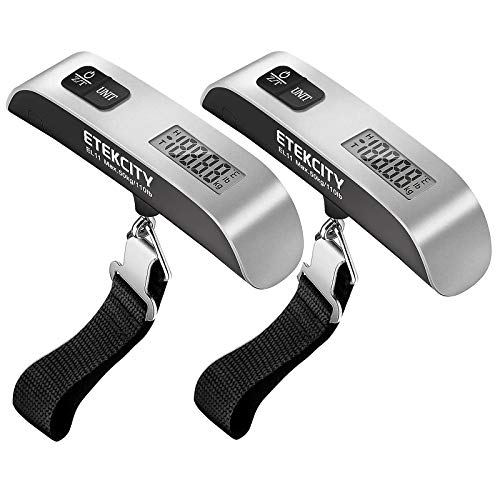
Etekcity Luggage Scale, Travel Essentials
Weight limits for checked bags are typically 50 pounds on US domestic flights. International flights may allow 23-32 kg (50-70 lbs) depending on the airline and fare class. Overweight fees range from $50-$200.
Measuring Soft-Sided vs. Hard-Sided Luggage
Hard-sided suitcases are easier to measure because the shell doesn’t change shape. Measure the exterior dimensions and you’re done. The number won’t change whether the bag is empty or packed.
Soft-sided bags expand when packed, which means the dimensions change based on how much you put inside. Measure a soft bag when it’s packed to your normal level – that’s the dimension the airline sees. Expansion zippers add 1-2 inches of depth when deployed, so decide before packing whether you’ll use the expansion and measure accordingly.
FAQ
Do airlines measure luggage with wheels?
Yes. Airlines measure the total exterior dimensions of the bag including wheels, handles, and any external features. A suitcase that measures 21 inches at the body is typically 22-23 inches with wheels and handle included.
What is 62 linear inches for luggage?
It’s the sum of your bag’s height + width + depth. For example, 28 + 20 + 14 = 62 linear inches. Most airlines set 62 linear inches as the maximum for standard checked bags. Bags over this limit incur oversized fees.
How do I know if my bag will fit in the overhead bin?
Most overhead bins accommodate bags up to 22 x 14 x 9 inches. Measure your bag with wheels and handle included. If you’re close to the limit, try soft-sided bags which compress slightly to fit. Hard-sided bags are all-or-nothing.
Why are luggage dimensions different on Amazon vs. the airline website?
Amazon listings usually show manufacturer dimensions, which often exclude wheels and handles. Airline size limits include everything. This mismatch is the most common reason bags get flagged as oversized at the gate. Always add 1-2 inches to Amazon dimensions to estimate the overall size.