


Updated June 2026.
This article contains affiliate links. We may earn a commission at no additional cost to you if you make a purchase through these links. See our affiliate disclosure for details.
A travel umbrella needs to do two things a regular umbrella doesn’t: fit in a bag without taking up half the space, and survive wind without inverting on a rainy sidewalk in an unfamiliar city. Most cheap compact umbrellas fail at the second part. The canopy inverts in moderate wind, the ribs bend, and you’re standing in the rain holding a broken umbrella 3,000 miles from home.
The difference between an $8 umbrella and a $22 one is wind resistance – specifically, whether the ribs are steel, fiberglass, or aluminum and how the canopy is tensioned. Here are six travel umbrellas organized by what you need them for.
Our Top Picks at a Glance

What Makes a Travel Umbrella Different
Compact size is the defining feature. A travel umbrella folds down to 10-12 inches – short enough to fit in a daypack, purse, or sling bag side pocket. Regular umbrellas run 24-30 inches collapsed and don’t fit in anything except your hand. The tradeoff is canopy coverage: compact umbrellas typically cover 38-42 inches versus 48+ for a full-size stick umbrella.
Wind resistance separates travel umbrellas you’ll use once from ones you’ll carry for years. The key component is the rib material. Fiberglass ribs flex under wind pressure and snap back to shape. Steel ribs are rigid but bend permanently. Aluminum ribs are light but brittle. For travel, fiberglass is the only correct answer – it’s why REPEL and TUMELLA outperform umbrellas that cost the same but use steel or aluminum ribs.
Auto open/close is worth having for one specific scenario: you’re walking out of a building into rain while holding bags, a coffee, or a phone. One-button open means you don’t need two free hands. Auto close is less essential but convenient for getting into a car or store quickly.
1. REPEL Windproof Travel Umbrella – Top Pick
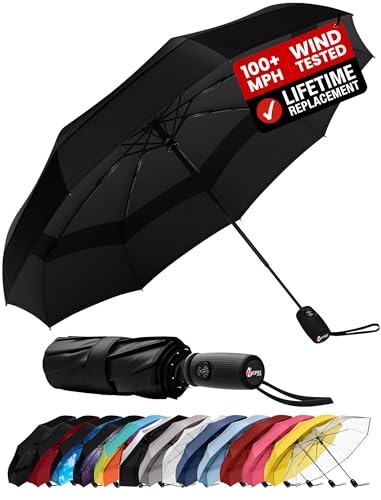
REPEL Windproof Travel Umbrella
REPEL owns the travel umbrella category on Amazon the way Band-Aid owns adhesive bandages – the brand is synonymous with the product. The 108,000+ review count is staggering for an umbrella, and the 4.4-star average across that volume means the product consistently delivers.
The Teflon coating on the canopy sheds water faster than uncoated nylon, so the umbrella dries quickly when you collapse it and put it in your bag. The 9 fiberglass ribs (most compact umbrellas have 6-8) provide more structural support in wind. REPEL claims 85 MPH wind resistance, which is marketing-speak – in real conditions, the umbrella handles 30-40 MPH gusts without inverting, which covers any weather a reasonable person would walk in.
The auto open/close button is responsive and the mechanism has held up across thousands of reviewer cycles. At $22, it’s the most expensive compact umbrella on this list, but the lifetime replacement guarantee means REPEL will send a new one if this one breaks. That guarantee is the real value proposition – you’re buying the last compact umbrella you’ll need to buy.
- 108,000+ reviews with 4.4-star average
- Teflon coating dries fast – better for bag storage
- 9 fiberglass ribs for wind resistance
- Lifetime replacement guarantee
- $22 is premium for a compact umbrella
- 42″ canopy doesn’t cover two people
- 85 MPH claim is unrealistic for any compact umbrella
- Weighs a full pound – heavier than ultralight competitors
The REPEL is the default recommendation. The Teflon coating, fiberglass ribs, and lifetime guarantee justify the $22 price when the alternative is buying a $9 umbrella three times. Pack it in your carry-on and forget about rain planning for the rest of the trip.
2. TUMELLA Windproof Umbrella – Best Mid-Range

TUMELLA Windproof Travel Umbrella
TUMELLA gets you a 46-inch canopy – 4 inches more coverage than REPEL – at a lower price. That extra coverage matters if you carry a bag on one shoulder that you want to keep dry, or if you’re taller than average and need more lateral coverage. The fiberglass rib construction handles wind similarly to REPEL, and the auto open/close mechanism works smoothly.
The lighter weight (~0.8 lbs vs REPEL’s ~1 lb) makes a noticeable difference in a daypack or purse. The canopy material is standard coated nylon – functional but it doesn’t shed water as quickly as REPEL’s Teflon coating. You’ll want to shake it off before collapsing it into your bag.
- 46″ canopy – more coverage than most compacts
- Lighter than REPEL at ~0.8 lbs
- Lower price with similar wind performance
- No Teflon coating – slower to dry
- Fewer reviews than REPEL – less proven track record
- Slightly longer collapsed length
TUMELLA is the pick for taller travelers or anyone who wants more canopy coverage at a lower price than REPEL. The tradeoff is no Teflon coating and a smaller review base. Functionally, it’s a strong alternative.
3. SIEPASA Compact Umbrella – Best Budget

SIEPASA Compact Travel Umbrella
At under $9, the SIEPASA is cheap enough to toss in your travel bag as a just-in-case item. It opens and closes with one button, fits in a daypack side pocket, and keeps you dry in normal rain. That’s the entire value proposition – a functional umbrella at the price of two airport coffees.
It won’t survive strong wind. The ribs are thinner than REPEL’s fiberglass, and sustained gusts above 25 MPH will invert the canopy. But for light rain and drizzle – the conditions that actually ruin sightseeing days – it does the job. The 10-rib design adds some structure, and at this weight (~0.7 lbs), you barely notice it in your bag.
Treat it as a semi-disposable travel tool. If it breaks on a windy day, you’re out $9. Most travelers who buy one end up using it for 6-12 months before anything fails.
- Under $9 – cheapest functional option
- Ultralight at ~0.7 lbs
- Auto open/close still included at this price
- Poor wind resistance above 25 MPH
- Thinner canopy material wears out in 6-12 months
SIEPASA is the umbrella you buy when you forgot to pack one and don’t want to spend $20 at the hotel gift shop. For light rain on travel days, it’s perfectly adequate. For anything beyond that, spend the extra $13 on REPEL.
4. Rain-Mate Compact Umbrella – Runner-Up Budget

Rain-Mate Compact Umbrella
Rain-Mate threads the needle between SIEPASA’s rock-bottom price and REPEL’s wind performance. The fiberglass-reinforced ribs handle gusts better than SIEPASA’s standard ribs, and the 42-inch canopy matches REPEL’s coverage. At under $10, that’s a lot of umbrella for the price.
The rubberized handle grip is a small detail that matters when your hands are wet. Smooth plastic handles get slippery in rain – the rubber coating provides traction. The auto open/close mechanism works reliably, and the carrying sleeve keeps it from dripping on everything in your bag.
- Fiberglass-reinforced ribs at a budget price
- 42″ canopy – same as REPEL
- Rubberized grip for wet hands
- No Teflon coating
- Fewer reviews than REPEL or SIEPASA
- No lifetime guarantee
Rain-Mate is the best value on this list. Fiberglass ribs at a $10 price point with a 42″ canopy – that combination doesn’t exist elsewhere. If you want wind resistance without paying $22, this is where to land.
5. Gorilla Grip Stick Umbrella – Best Full-Size

Gorilla Grip Stick Umbrella
The Gorilla Grip isn’t technically a “travel” umbrella – it’s a full-size stick umbrella that some travelers prefer because it covers more and handles wind better than any compact design. The 48″+ canopy protects two people walking side by side, and the longer shaft gives the ribs more leverage to resist inversion.
The obvious downside is it doesn’t fit in a bag. You’re carrying it in your hand or hooking it on your arm, which means it’s a commitment – you bring it when you know rain is coming, not as a just-in-case item. For cities where rain is a daily occurrence (London, Seattle, Tokyo in rainy season), having a full-size umbrella at the hotel makes more sense than relying on a compact.
- 48″+ canopy covers two people
- Better wind resistance than compact designs
- Quick-dry fabric
- Under $10
- Won’t fit in a bag – must carry
- Not practical for uncertain weather
- Takes up overhead bin space on planes
The Gorilla Grip is for travelers going to rainy destinations who know they’ll use an umbrella daily. It outperforms every compact on this list in coverage and wind resistance. For packing versatility, stick with a compact.
6. BAODINI UV Protection Umbrella – Best Sun and Rain

BAODINI UV Protection Umbrella
In Southeast Asia, Japan, and much of the tropics, umbrellas are as much about sun as rain. The BAODINI has a black UV-blocking coating on the underside of the canopy that blocks UPF 50+ of ultraviolet radiation – the same protection level as strong sunscreen. For travelers visiting hot, sunny destinations where you’re walking outdoors for hours, a sun umbrella reduces heat exposure measurably.
The dual-purpose design means you don’t need separate rain and sun umbrellas. The rain side works like any other compact umbrella. The UV side provides shade that feels 10-15 degrees cooler underneath. It’s a common accessory in Asian countries and gaining popularity with Western travelers who’ve experienced the difference.
Wind resistance is weaker than REPEL – the UV coating adds weight to the canopy that makes it more susceptible to catching gusts. This is a fair-weather umbrella, not a storm umbrella. For travelers heading to destinations where packing light matters but sun protection is non-negotiable, it’s a smart two-in-one.
- UPF 50+ sun protection – genuine UV blocking
- Dual rain/sun use eliminates carrying two items
- Feels noticeably cooler underneath in direct sun
- Weaker wind resistance than rain-focused umbrellas
- UV coating adds canopy weight
- Fewer reviews – less proven long-term
The BAODINI is the pick for tropical and hot-weather travel where sun exposure is the bigger concern. If you’re heading to Thailand, Spain, or Arizona and plan to walk outdoors, the UV protection is genuinely useful. For rainy northern cities, stick with REPEL.
FAQ
What size travel umbrella should I get?
A 42″ canopy covers one person comfortably. 46″ covers one person with a bag or provides tight coverage for two. Under 40″ leaves your shoulders exposed in anything more than drizzle. For solo travel, 42″ is the sweet spot – it’s the most common size for compact travel umbrellas.
Are windproof umbrellas actually windproof?
No umbrella is truly windproof – strong enough wind will defeat any design. “Windproof” in the travel umbrella market means fiberglass ribs that flex and snap back instead of bending permanently. A good windproof compact umbrella handles 30-40 MPH gusts. Above that, you should be indoors.
Should I pack an umbrella or buy one at my destination?
Pack one. Airport and hotel umbrellas cost 3-5x retail, and the quality is usually poor. A compact travel umbrella weighs under a pound and fits in any bag. The one time you need it and don’t have it costs more in discomfort than the umbrella costs in bag space.
Do I need a UV umbrella?
For tropical, equatorial, or desert destinations where you’ll be walking outdoors for hours – yes, it makes a measurable difference in comfort and sun exposure. For temperate climates or trips where you’re mostly indoors, a standard rain umbrella is enough. If you only carry one umbrella, the BAODINI’s dual rain/sun function covers both scenarios.