Osprey Farpoint 55 Review (2026): The Backpacker Go-To

This article contains affiliate links. We may earn a commission at no additional cost to you if you make a purchase through these links. See our affiliate disclosure for details. As an Amazon Associate I earn from qualifying purchases.
The Osprey Farpoint 55 is a 55-liter travel pack that splits into a 40-liter main bag and a 15-liter daypack, attached for transit or used separately. Long-term travelers buy it because that split covers a month of clothes plus a small bag for daily exploring.
Long-term owner reviews tell a consistent story: the pack holds up over months on the road, the 40L main bag detaches and passes as a carry-on, and the daypack saves people from buying a separate bag for temple visits and day hikes.
Osprey Farpoint 55 Overview
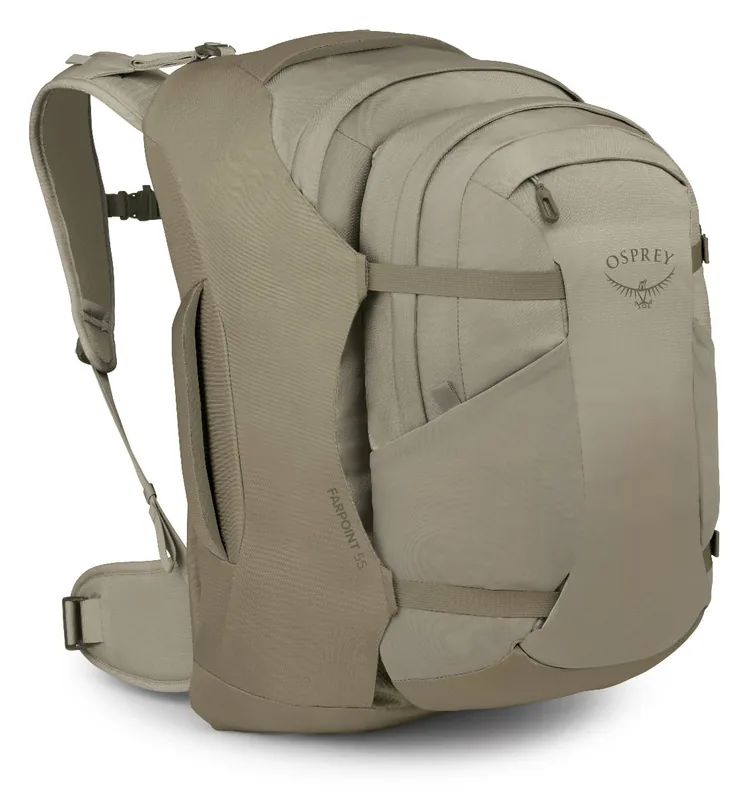
Osprey Farpoint 55 Travel Pack
A 40L main pack and a detachable 15L daypack that work together or apart.
The Two-Bag System
The Farpoint 55’s defining feature is the split design. The 40-liter main pack carries your clothes, toiletries, and gear. The 15-liter daypack zips onto the front of the main bag for transit days, or detaches for daily use at your destination.

Without the daypack, you either dig through the main pack every time you leave the hostel or you buy a second bag. Arrive at your destination, unzip the daypack, toss in your wallet and water bottle, and leave the main bag at the hostel.
The daypack is basic: one main compartment, one front pocket, mesh water bottle pockets on the sides. It’s not padded enough for a laptop, but it handles a tablet, book, camera, and daily essentials. If you want more from a daypack, the Osprey Daylite 26+6 daypack adds structure and a real harness.
Carrying Comfort
Osprey’s LightWire frame suspension is what separates the Farpoint from cheaper travel packs. The frame transfers weight from your shoulders to your hips, which means you can carry a full 55-liter load for hours without your shoulders burning.
The hip belt is padded and contoured. It cinches tight and stays put, with no slide-down on long walks. The shoulder straps have Osprey’s signature mesh padding that breathes better than foam. There’s a sternum strap with a safety whistle built in.
The entire harness zips behind a panel for transit. When you’re checking the bag as luggage or throwing it in a bus’s cargo hold, the straps tuck away so they don’t get caught, torn, or dirty. Exposed straps on a checked or bus-stowed backpack snag, tear, and pick up dirt. A lot of competing travel packs leave the straps exposed.
Comfort falls off sharply above 35 lbs. The Farpoint is designed for travel loads, not expedition loads. If you’re packing heavy books, camera gear, and camping equipment, you want a dedicated hiking pack with a beefier frame. For 20-30 lbs of clothes and travel gear, the Farpoint carries well.

Packing and Organization
The main compartment opens with a U-shaped front panel zip, suitcase-style. That beats top-loading for travel: you can see and access everything without pulling items out from the top. Internal compression straps hold clothes in place, and a mesh divider panel zips across to keep one side separate.
There’s a padded laptop/tablet sleeve in the back panel (fits up to 16 inches) and a zippered pocket in the front lid for documents, chargers, and small items. The external compression straps cinch the bag down when it’s not fully packed, reducing the profile and keeping the load stable.
What’s missing: no external water bottle pockets on the main bag (the daypack has them), no hip belt pockets, and no dedicated shoe compartment. The Farpoint 40 (without the daypack) has recently been updated with external water bottle pockets, but the 55 relies on the daypack for that.
As a Carry-On
The 40L main bag (without the daypack attached) measures approximately 22 x 14 x 9 inches. That’s right at the carry-on limit for most airlines. Whether it actually fits depends on how tightly you pack it. A loosely packed Farpoint 40 bulges beyond the sizer. A compression-strapped tight pack slides in.
Budget airlines (Frontier, Ryanair) will likely require you to check it. Full-service carriers (Delta, United, American) are more lenient, and owner reports of a Farpoint 40 being turned away on a major US airline are rare.
With the daypack attached (full 55L configuration), it’s a checked bag. No airline will let 55 liters into the overhead bin. The daypack becomes your personal item, and the main bag goes overhead or under the bus.
For airline size requirements on checked bags, the Farpoint 55 is well within the 62 linear inch limit at roughly 45 linear inches.
Durability
The 210D nylon ripstop fabric is lighter than what Osprey uses on their hiking packs, but it holds up well for travel. Long-term owner reviews describe packs that pick up scuffs and minor abrasion from bus luggage compartments and hostel floors without tears or structural damage. Heavier fabrics hold up better at the cost of weight, which is the trade-off on a waxed G-1000 fabric daypack.
Owner reports describe zippers that stay smooth. The buckles are Osprey’s standard hardware, which break rarely, and the All Mighty Guarantee covers repair or replacement if something fails. Osprey’s warranty is more aggressive than most pack makers’.
The weakest point is the daypack attachment system. The zippers that connect the daypack to the main bag see a lot of use and stress. After heavy use, the teeth can start to resist. Keeping them clean and occasionally applying zipper lubricant prevents this.
Farpoint 55 vs. Farpoint 40
The Farpoint 40 is the same main bag without the daypack, and it’s the more popular choice for travelers who plan to pack light. If you’re comfortable with 40 liters (enough for 1-2 weeks with efficient packing), the Farpoint 40 is lighter, cheaper, and more airline-friendly.
The Farpoint 55 makes sense if you’re traveling for a month or more, if you don’t want to buy a separate daypack, or if you tend to accumulate stuff on the road. That extra 15 liters of daypack space is genuinely useful for groceries, souvenirs, or day-trip supplies.
Who Should Buy the Farpoint 55
Long-term travelers (3+ weeks), backpackers doing multi-city trips, and anyone who wants a single purchase to cover both transit and daily carry. The two-bag system is the reason to buy this model. If you don’t need the daypack, buy the Farpoint 40 instead.
The Farpoint 55 is a poor fit if you prefer rolling luggage (this is a backpack-only solution), if you fly budget airlines frequently (it’s borderline for carry-on as the 40L alone), or if you need a hiking load (get an Osprey Atmos or Aether instead). For straight one-bag travel without the daypack, the Osprey Porter 46 travel pack is the other Osprey worth comparing.
- Detachable 15L daypack included
- LightWire frame transfers weight to hips
- Suitcase-style front panel opening
- Harness tucks away for transit
- Osprey All Mighty Guarantee (lifetime warranty)
- 40L main bag works as carry-on on most airlines
- No water bottle pockets on main bag
- No hip belt pockets
- Comfort drops above 35 lbs
- Daypack lacks laptop padding
- Borderline carry-on size when fully packed
The two-bag system covers daily carry without a second purchase, and the LightWire frame is comfortable enough for long transit days. Missing water bottle pockets on the main bag is a real gap. For the price, and with the daypack included, it is still the long-term travel pack most backpackers land on.
FAQ
Is the Osprey Farpoint 55 carry-on size?
The 40L main bag (without the daypack) is approximately carry-on size at 22 x 14 x 9 inches. It fits on most full-service airlines when packed tightly. Budget airlines with strict sizers may require you to check it. The full 55L configuration (with daypack attached) is too large for carry-on.
Is the Farpoint 55 good for backpacking Southeast Asia?
It’s one of the most popular packs for Southeast Asia travel. The 55L total volume handles 3-4 weeks of tropical clothing, the daypack works for temple visits and day trips, and the harness tucks away for bus and boat storage. The 210D nylon handles humidity and rough handling well.
What’s the difference between the Farpoint and Fairview?
The Fairview is Osprey’s women’s-specific version of the Farpoint. Same design, same features, but with shorter torso length, narrower shoulder straps, and contoured hip belt designed for a female frame. If you have a shorter torso (under 18 inches), the Fairview is the better fit regardless of gender.
How long does the Osprey Farpoint 55 last?
Osprey publishes its All Mighty Guarantee for the Farpoint, subject to the current terms. Actual service life depends on loading, abrasion, care, and travel frequency.
Can you fit a laptop in the Osprey Farpoint 55?
Yes. The main bag has a padded laptop/tablet sleeve in the back panel that fits up to 16 inches. The daypack doesn’t have a padded laptop sleeve, so it fits a tablet but a laptop would be unprotected. Keep your laptop in the main bag’s dedicated sleeve.
Filed in Luggage Reviews