
Updated August 2026.
This article contains affiliate links. We may earn a commission at no additional cost to you if you make a purchase through these links. See our affiliate disclosure for details.
A personal item backpack is sized to fit under the airplane seat in front of you. Every airline lets you bring one in addition to your carry-on, and budget airlines like Spirit and Frontier make it your only free bag. Getting the dimensions right means free luggage on every flight; getting them wrong means paying a gate fee for a bag you thought was free.
The catch is that “personal item” sizing varies by airline, and most backpacks don’t list their dimensions in a way that makes it easy to check. Here’s what actually fits, what the airlines allow, and how to pick a backpack that qualifies.
Personal Item Size Limits by Airline
Most airlines allow personal items up to 18 x 14 x 8 inches (45 x 35 x 20 cm). That’s the standard that Delta, American, United, Southwest, and JetBlue use. Budget airlines are stricter:
Spirit Airlines: 18 x 14 x 8 inches (same as mainline, but they actually enforce it).
Frontier Airlines: 18 x 14 x 8 inches (same dimensions, strict enforcement).
Allegiant Air: 16 x 15 x 7 inches (smaller than most – check your bag carefully).
The difference between mainline and budget carriers isn’t the size limit – it’s enforcement. Delta gate agents rarely measure personal items. Spirit agents will put your bag in the sizer box if it looks borderline. If you’re flying budget carriers, err on the side of a smaller bag. For a full breakdown by carrier, we covered what you can bring on flights.
What Makes a Good Personal Item Backpack
Structured but compressible. The best personal item backpacks hold their shape when full (so you can organize your stuff) but compress slightly when under-packed (so they squeeze into the sizer box). Soft-sided nylon packs do this naturally. Rigid hardside bags don’t compress, which is riskier for strict sizing.
Flat profile matters. The 8-inch depth limit is what trips most people up. Regular daypacks bulge to 10-12 inches when packed, even if they technically measure 8 inches empty. Look for backpacks with a flat back panel and compression straps that cinch the depth down.
Laptop sleeve is essential. You’re bringing this bag on a plane, and you almost certainly have a laptop or tablet. A padded sleeve against the back panel protects your electronics and makes the bag lay flat under the seat. It is the same feature that decides a good commute backpack, where pulling a laptop out quickly matters more than raw capacity.
Quick access pockets on the top or front panel let you grab your boarding pass, passport, or earbuds without unpacking the whole bag during boarding. This matters in the aisle when people are waiting behind you.
Personal Item Backpack vs. Regular Daypack
A regular 28-liter daypack (like the North Face Borealis) technically exceeds personal item dimensions on most airlines. It might fit under the seat, but it’ll bulge and you risk getting flagged by strict carriers. Purpose-built personal item backpacks stay within the 18 x 14 x 8 envelope, which means they max out around 18-20 liters.
That 8-10 liter difference matters. A regular daypack carries more, but a personal item backpack flies free on every airline without risk. If you’re flying budget carriers regularly, the personal item backpack pays for itself in avoided bag fees within one or two flights.
The Backpacks That Actually Fit the Envelope
These three are built to the 18 x 14 x 8 spec rather than squeezed into it, which is the difference that matters at a Spirit or Frontier gate.

ECOHUB Travel Backpack 18x14x8 Spirit Airlines...
The ECOHUB is the one we would hand someone flying Spirit for the first time. It is cut to the exact personal item box, the pocket count keeps a boarding pass and passport reachable without opening the main compartment, and the soft shell gives just enough when the bag is full.

WANDF Personal Item Travel Bag 18x14x8, Carry On...
The WANDF opens flat like a suitcase, so packing it is closer to laying clothes in a shell than stuffing a daypack from the top. That flat back panel is also what lets it slide under a seat without the bulge that gets bags pulled at the gate.
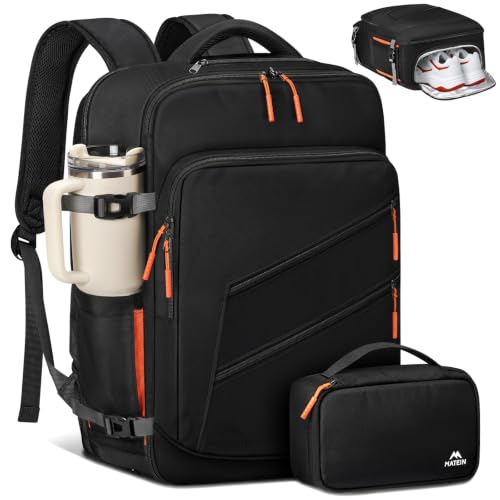
MATEIN Personal Item Backpack, Carryon Bag with...
The MATEIN takes the same envelope and splits it up: a padded laptop sleeve against the back, a separate shoe compartment you can pull out when you do not need it, and enough internal structure that the bag holds its shape half empty.
Packing a Personal Item for a Weekend Trip
With smart packing, an 18L personal item backpack can cover a weekend trip as your only bag. Roll clothes instead of folding. Use compression packing cubes to maximize space. Wear your bulkiest items (jacket, boots) on the plane. A typical weekend kit: 2 shirts, 1 pair of pants, underwear, socks, toiletries (in a quart bag), phone charger, earbuds, and a book or tablet.
For longer trips, use the personal item for electronics and essentials and add a carry-on roller for clothes. The personal item goes under the seat, the roller goes overhead. Two bags, no checked luggage, no fees on mainline carriers.
At a Glance: Personal Item Backpacks
FAQ
What backpack qualifies as a personal item?
Any backpack that fits within 18 x 14 x 8 inches (the standard personal item size for most airlines). This typically means backpacks under 20 liters with a flat profile. Purpose-built personal item backpacks are designed to maximize capacity within these limits.
Is a Jansport backpack a personal item?
Most standard JanSport backpacks (SuperBreak, Right Pack) are borderline. They technically fit the dimensions empty, but when packed they often exceed the 8-inch depth limit. On mainline airlines that don’t enforce strictly, they usually pass. On Spirit or Frontier, they’re a gamble.
Can I bring a personal item AND a carry-on?
On mainline airlines (Delta, United, American, Southwest, JetBlue), yes – you get one carry-on plus one personal item for free. On basic economy fares and budget carriers (Spirit, Frontier), you may only get a personal item for free and pay extra for a carry-on.
What’s the biggest backpack that counts as a personal item?
Roughly 18-20 liters in a flat profile (under 8 inches deep). Some brands make “personal item” backpacks specifically designed to hit the maximum allowed dimensions. These typically measure 17.5 x 13 x 7.5 inches, just under the limits.