
Updated August 2026.
This article contains affiliate links. We may earn a commission at no additional cost to you if you make a purchase through these links. See our affiliate disclosure for details.
Small backpacks fill the gap between a sling bag and a full daypack. They’re typically 10-20 liters, carry more than a crossbody but don’t look like you’re heading to class with a loaded school bag. The category covers everything from fashion mini-backpacks to compact hiking packs to slim commuter bags.
The tricky part is finding one that’s actually small enough to qualify as “small” without being too small to carry anything useful. Here’s what to look for and who each style works best for.
What Counts as a Small Backpack
Most people mean 10-20 liters when they say “small backpack.” Under 10 liters and you’re in mini-backpack or sling bag territory. Over 20 liters and it’s a standard daypack. The 10-20 liter range carries a water bottle, a light jacket, a wallet, phone, keys, snacks, and maybe a slim notebook or tablet. It won’t fit a full-size laptop in most cases – that’s the main tradeoff.
The shape matters as much as the volume. A 15-liter pack that’s tall and narrow sits differently on your back than one that’s wide and flat. Taller profiles look more like a shrunken regular backpack. Wider, flatter profiles look more intentionally compact and tend to sit better on smaller frames.
When a Small Backpack Makes Sense
Day trips and sightseeing are the primary use case. You need enough room for water, sunscreen, a camera, and a packable rain jacket, but you don’t want to haul a 30-liter pack through a museum. A 15-liter bag covers this perfectly. It fits under a restaurant chair without taking up floor space and doesn’t scream “tourist” the way a full daypack does.
Commuting without a laptop works well too. If your workplace provides a computer and you just need to carry lunch, headphones, a charger, and personal items, a small backpack handles the load without looking like you’re going on a hike. Some compact models even pass as personal items on flights.
Theme parks and outdoor events are another strong fit. You’re on your feet all day, space in lines and on rides is tight, and you need your essentials accessible. A small, lightweight backpack distributes weight across both shoulders (better than a crossbody for 8-10 hours) without getting in the way. And for everyday errands – grocery runs, farmer’s markets, dog walks – a small backpack keeps your hands free without the bulk of a full daypack.
What to Look for
A sternum strap prevents the shoulder straps from sliding off on smaller frames. This is especially useful for women and people with narrow shoulders. Not every small backpack includes one, but it makes a noticeable difference in comfort and stability.
Water bottle pockets are non-negotiable on small packs because there’s no room for a bottle inside the main compartment. If the pack doesn’t have side pockets, you’ll end up holding your water bottle or clipping it to the outside with a carabiner.
Check the strap padding. Some small backpacks use thin, unpadded straps because designers assume a small pack means a light load. That’s true for light loads, but even 5-6 pounds of water, snacks, and a camera gets uncomfortable on bare nylon straps after a few hours.
Three Small Backpacks Worth Buying
The category splits three ways in practice: a hiking daypack, a commuter pack, and an everyday bag chosen mostly for how it looks. One of these three covers whichever trip you take most.
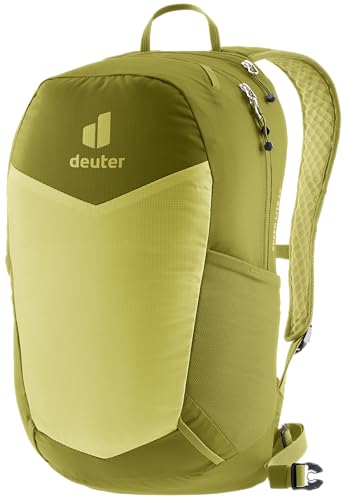
Deuter Speed Lite 13L Hiking Day Backpack
Thirteen liters at under a pound is the sweet spot described above: water, a rain shell, snacks, and a camera, with nothing left over to tempt you into overpacking. The hiking cut buys real shoulder padding and a harness that stays put, which is what separates a comfortable eight hour day from a sore one.

Pacsafe Metrosafe LS350 15 Liter Anti Theft Laptop Daypack/Backpack
This is the exception to the rule that a small pack cannot carry a computer. Fifteen liters with a padded 13 inch sleeve, plus locking zippers and slash resistant panels, which matter more on a crowded train than they ever will on a trail. It is the heaviest of the three, and the security hardware is where that weight goes.

Fjällräven Kanken Backpack - Durable Vinylon Fabric
The Kanken is the fashion end of the category and makes no apology for it. Sixteen liters of Vinylon F, a boxy shape that stands up on its own, and flat straps rather than the contoured padding on the other two. Buy it for the look and for how long the fabric lasts, not for hauling five pounds through a theme park.
At a Glance
Small Backpack vs. Sling Bag
The main advantage of a small backpack over a sling bag is weight distribution. Two straps spread the load across both shoulders, which matters less at 2 pounds and a lot more at 5+. Sling bags are faster to access (swing to front) but less comfortable for heavier loads or all-day carries.
If your carry is phone, wallet, keys – go sling. If you’re adding water, snacks, sunscreen, a jacket – go small backpack. The crossover point is roughly 3-4 pounds of gear.
FAQ
What size is a small backpack?
10-20 liters. Under 10L is a mini-backpack or sling. Over 20L is a standard daypack. 15L is the most common size for “small” backpacks and covers most day-trip needs.
Can a small backpack be a personal item on a plane?
Most small backpacks (under 18L) fit under an airplane seat and qualify as a personal item. Check your airline’s specific dimensions, but anything under 18 x 14 x 8 inches should work on all major carriers.
Are small backpacks good for hiking?
For short day hikes (under 5 miles) with light loads, yes. For longer hikes or heavier gear, you’ll want a purpose-built hiking daypack with better suspension and a hip belt. Small backpacks lack the load-transfer features that make carrying 10+ pounds comfortable on trails.
What can you fit in a 15L backpack?
A 15L backpack fits a water bottle, light jacket, wallet, phone, keys, sunscreen, snacks, sunglasses, and a small camera or book. It won’t fit a full-size laptop (most need 20L+) or a change of clothes. Think of it as a carry for 6-8 hours away from home.