Best Travel Backpack for Men 2026

Updated August 2026.
This article contains affiliate links. We may earn a commission at no additional cost to you if you make a purchase through these links. See our affiliate disclosure for details.
Finding a travel backpack that actually fits the male frame takes more work than most guides let on. Torso length, shoulder width, and hipbelt sizing all differ between men’s and unisex packs, and that difference shows up after about 20 minutes of walking through an airport terminal. The wrong pack digs into your shoulders. The right one disappears on your back.
We compared carry-on-friendly travel backpacks across four price points, working from published specifications and owner reviews, from a budget-friendly option to an expandable pack built for photographers and weekend travelers alike. Every pick below opens like a suitcase (not a top-loader), fits in an overhead bin, and has room for a laptop. The differences come down to materials and internal organization. If you want a second opinion on any of them, Pack Hacker’s gear reviews cover most of the same packs.
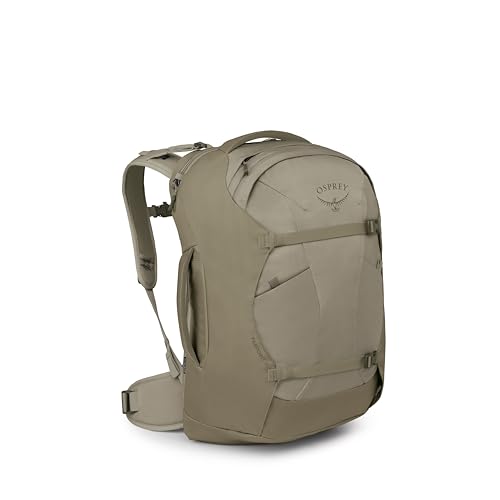
1. Osprey Farpoint 40
Osprey Farpoint 40
Men's-specific harness, stowaway suspension, and a 40L carry-on profile that handles airports and light trails equally well.
$197.69 on Amazon, price may vary
Osprey has been making the Farpoint for years, and the current version is their most refined take on the carry-on travel backpack. The 40-liter capacity hits the sweet spot: enough room for a week’s worth of clothes when you pack with some discipline, small enough to fit in most overhead bins without checking.
What separates the Farpoint from unisex travel packs is the men’s-specific harness. The shoulder straps are cut wider and the hipbelt sits lower, which matters when you’re carrying 20-plus pounds through a connecting terminal. The WingJacket compression system squeezes the load against your back for stability, and a direct-zip 3-1-1 pocket means you don’t need to dig through your main compartment at TSA. A harness cut to the body is the whole argument for an ergonomic backpack.
- Adjustable torso length fits a wide range of body types
- Harness and hipbelt stow away completely for checked bags
- Dedicated 3-1-1 toiletry pocket saves time at security
- Osprey’s All Mighty Guarantee covers repairs for life
- No built-in rain cover (sold separately)
- Laptop sleeve accessible only from inside the main compartment
The Farpoint 40 is the pack we’d grab for a 5-10 day trip where we’re moving between cities. The men’s-specific fit genuinely makes a difference on long carry days, and Osprey’s warranty means you’re buying this pack once. If you want a single backpack that handles airports, trains, and light trails, this is it.
2. Peak Design Travel Backpack 45L

Peak Design Travel Backpack 45L, Black, Expandable 35-45L Design
Peak Design made its name with camera bags, and that heritage shows in how the Travel Backpack handles organization. The rear-access panel opens flat like a suitcase, but you reach your laptop from the back of the bag: a security detail that means nobody can unzip your laptop sleeve while you’re wearing it. The MagLatch top closure clips magnetically with one hand, which sounds like a gimmick until you’re juggling a boarding pass and a coffee.
The expansion system is the real selling point. At 35L, the pack meets every major airline’s carry-on requirements. Unzip the expansion panel and you’ve got 45L for the return trip when you’ve inevitably bought things. You’re paying a premium for recycled nylon construction and engineering details like hidden strap storage and an internal camera cube mount, but the build quality justifies the price for frequent travelers.
- Expandable 35-45L means one bag fits every trip length
- Rear laptop access keeps your gear secure in crowded spaces
- Weatherproof without needing a separate rain cover
- Recycled 400D nylon shell with no performance trade-off
- Camera cube compatible for photographer travelers
- The highest price on this list
- Weighs 4.5 lbs empty, heavier than most competitors
- Expanded to 45L it can exceed strict budget-airline size limits
The Peak Design Travel Backpack is built for men who travel frequently enough to justify the investment. The expandable design means you don’t need separate bags for weekend and week-long trips, and the camera cube compatibility makes it a standout for photographers. If the price feels steep, you’ll use this pack for years.
3. Cotopaxi Allpa 35L

Cotopaxi Allpa 35L Travel Pack, Black
Cotopaxi donates 1% of revenue to addressing poverty and funds community grants in the countries where their products are made. That’s worth mentioning because the Allpa 35L doesn’t ask you to sacrifice anything for the sustainable angle: it’s a genuinely well-designed travel backpack that competes on features alone. Some bags sell on identity instead of specs, which is how the Sprayground graphic backpack line built its following.
The suitcase-style full-zip opening splits the pack into two halves, each with mesh compression panels that keep your clothes in place. Internal stash pockets line the perimeter for cables, chargers, and small items. The hipbelt is padded enough to handle loaded carries, and the shoulder straps include a sternum strap. At 35L, it’s 5 liters smaller than some competitors, but the efficient internal layout uses every inch. The shell is 100% recycled 840D TPU-coated nylon with a ballistic ripstop nylon base.
- Lockable zippers for security in hostels and transit
- 100% recycled 840D nylon with TPU weather coating
- Suitcase-style opening makes packing intuitive
- Del Día colorways use leftover fabric (each bag is unique)
- 35L feels tight for trips longer than a week
- No external water bottle pocket
- Hipbelt isn’t removable
The Allpa 35L works best for the traveler who packs light and wants a bag that reflects how they think about consumption. The lockable zippers add peace of mind for hostel stays, and the internal layout is smart enough to skip packing cubes entirely if you want to. If you want a spare bag for day trips, a packable daypack folds down into its own pocket.
4. MATEIN Carry on Backpack

MATEIN Carry on Backpack, Extra Large Expandable
At this price point, the MATEIN Carry on Backpack delivers a functional 40-liter (expandable to 45L) travel backpack with features that typically cost significantly more. Hideaway padded shoulder straps and a luggage pass-through strap let it ride on top of a roller through the terminal, and the zippers are lockable, a security feature you rarely see at this price.
The water-resistant polyester handles light rain but won’t survive a sustained downpour. For a few trips a year, the MATEIN gets the job done at a fraction of the cost of premium picks. It has a long enough track record that its limits are well documented, and it holds the Best Seller badge in its category.
- Expandable from 40L to 45L with one zipper
- Hideaway padded shoulder straps for overhead bin storage
- Luggage pass-through strap slides over a rolling bag handle
- Lockable zippers for transit security
- Weighs 2.2 lbs empty, light for a 40L pack
- Polyester shell won’t last as long as nylon alternatives
- No hipbelt, all weight sits on your shoulders
- Zippers feel lighter than YKK equivalents
The MATEIN is the right call if you travel a few times a year and don’t want to spend heavily on a backpack. The expandable capacity and luggage pass-through make it surprisingly functional out of the box. Just don’t expect it to survive years of heavy daily use: it’s a budget pick that knows what it is.
What to Look for in a Men’s Travel Backpack
Torso Fit and Harness Design
A men’s-specific travel backpack differs from a unisex model in shoulder strap width, hipbelt position, and torso length range. Men’s straps are cut wider to sit flat across broader shoulders. The hipbelt rides lower to match a male hip-to-waist ratio. And the torso adjustment range (when available) starts longer. If you’ve tried a unisex pack and felt the hipbelt riding up into your ribcage, a men’s-specific fit fixes that.
How to Measure Your Torso
Every harness chart runs on one number: the distance along your spine from the C7 vertebra down to the top of your hip bones. C7 is the bump that stands out at the base of your neck when you tilt your head forward. The top of the hip bones is the shelf you feel when you put your hands on your waist with your thumbs pointing back.
- Stand upright, feet shoulder-width apart, head tilted forward so your neck lines up with your spine.
- Have someone find C7 and hold a finger on it.
- Put your hands on your hips with your thumbs pointing back toward your spine.
- Have them run the tape from C7 down the spine to the line between your thumbs, and read it in inches.
Get someone else to hold the tape. Measuring your own back accurately is close to impossible, and an inch of error is the difference between two harness sizes. Height is not a substitute for this number, which is why two people of the same height often need different pack sizes.
If You Are Tall
Height is not the measurement that decides fit. Torso length is, and the two track less closely than people assume. A 6 foot 2 traveler with long legs and a short torso often fits a regular harness, while a 5 foot 10 traveler with a long torso does not.
So read the harness spec rather than the model name. On a fixed-harness pack, check the listed torso range first and skip the bag if your measurement sits at the very top of it. On an adjustable pack, check that the range extends past your number instead of ending at it, because a harness set to its limit leaves nothing to fine-tune once the bag is loaded. Two smaller details matter on a long back: the height of the top grab handle, and how far the sternum strap track slides, since both are set for an average torso and ride high on a tall one.
Capacity and Carry-On Compliance
Most airlines allow carry-on bags up to 22 x 14 x 9 inches. Travel backpacks in the 35-45L range generally fit within those dimensions, though a fully packed 45L bag can push the limits on strict carriers like Ryanair. For domestic flights, 40L is the sweet spot. For budget European carriers, 35L or an expandable pack gives you more flexibility.
Material Durability
Nylon outlasts polyester for travel backpacks. A 400D nylon shell handles abrasion from overhead bins and airport floors better than the same denier in polyester. That said, recycled fabrics have closed the gap significantly: Cotopaxi’s 840D shell is 100% recycled nylon and gives up nothing to virgin fabric in daily use. The real durability indicator is the zipper brand. YKK zippers cost more to source, which is why budget packs skip them. Over thousands of open-close cycles, YKK zippers stay smooth while unbranded alternatives start catching.
Organization and Access
Front-loading clamshell backpacks like the Aer Travel Pack 3 open the bag flat like a suitcase. Top-loading designs require you to pull things out from the top. For travel, front-loading wins every time. You can see everything in the bag at once, and packing cubes lay flat instead of stacking vertically. A separate laptop compartment accessible from the outside (or the back panel) saves you from unpacking your clothes to reach your computer. For work trips where the laptop matters more than the clothes, a laptop messenger bag for commuting covers the same job in a flatter shape.
Sizing by Trip Length
Capacity is measured in liters, and the number you need follows the trip rather than the bag you like the look of. Under 20 liters is a daypack for commuting and sightseeing. Twenty to 45 covers an overnight through three nights, which is where carry-on travel lives. Forty-five to 65 is extended travel with gear. Past 65 liters you are in expedition territory, hauling a tent and a sleeping bag.
The common mistake is buying too big. A half-empty 65 liter pack lets its load shift with every step, and that shifting lands on your hips and shoulders, while the empty space is an open invitation to fill it. A snug 40 forces the decision at home instead. For city travel and carry-on flying, 30 to 40 liters holds four or five days of clothes, a laptop and toiletries without checking a bag.
The Pre-Purchase Checklist
- Know your torso length and buy the harness to that number, not to your height.
- Pick capacity by trip type. Too small is the cheaper mistake.
- Check the fabric denier. 300D is the floor for daily use, 500D and up for travel that involves baggage handlers.
- Test the hip belt. It should carry weight, not decorate your waist.
- Open and close it fully loaded, in the store or inside the return window, because access patterns only show themselves when the bag is full.
- Verify airline compliance against your carrier’s published dimensions if you are flying carry-on.
At a Glance: All Four Side by Side
FAQ
What size travel backpack should a man carry on a plane?
35-40L fits within most airline carry-on limits (22 x 14 x 9 inches). A 40L pack handles a week of clothes when packed efficiently. If you fly budget carriers in Europe or Asia, stick to 35L or check your airline’s specific size requirements before flying.
Do I need a men’s-specific travel backpack or will unisex work?
It depends on your build. Men with broader shoulders and longer torsos will notice the difference: men’s-specific straps sit flatter and the hipbelt transfers weight more effectively. If you’re average build and the pack is under 15 pounds loaded, unisex works fine. Over 15 pounds, a men’s fit reduces shoulder fatigue.
Is 40L enough for a week of travel?
Yes, if you pack strategically. Roll your clothes, use packing cubes, and wear your bulkiest items on the plane. A 40L pack comfortably holds 5-7 days of clothes, toiletries, a laptop, and a pair of shoes. For trips beyond 10 days, you’ll either need to do laundry or step up to a 45L expandable pack.
What’s the difference between a travel backpack and a hiking backpack?
Travel backpacks open from the front or side like a suitcase, have dedicated laptop compartments, and meet carry-on dimensions. Hiking backpacks load from the top, prioritize external attachment points for gear, and are often taller than carry-on limits allow. Some packs (like the Osprey Farpoint) bridge both categories, but purpose-built travel packs handle airports and hotels better.
Can I use a travel backpack as my only bag?
For trips up to 10 days, absolutely. The one-bag travel approach works best with a 35-45L pack that has good internal organization. You’ll want a pack with a separate laptop compartment, internal compression straps, and a quick-access pocket for documents. Every pack on this list supports one-bag travel for at least a week.
Filed in Luggage Reviews