Best Travel Pillows in 2026: 6 Picks for Long Flights

Updated August 2026.
This article contains affiliate links. We may earn a commission at no additional cost to you if you make a purchase through these links. See our affiliate disclosure for details.
Most travel pillows fail the same way. They hold your head where you think it should go, upright and centered, and then you actually fall asleep and your head goes somewhere else. It drops forward until your chin hits your chest, or it slides sideways toward the window, and either way you’re awake again twenty minutes into the flight.
The more useful question is which shape matches the way you sleep. The six pillows here are different objects: a scarf with a support rib inside it, a U-shape built to catch the chin, a compact foam pillow for hotel beds, a hood that shuts the cabin out, an inflatable that packs down to nothing, and a cheap kit that covers the basics. We’ve ranked them, but the ranking matters less than the match.
Match the Shape Before You Match the Brand
Work out where your head goes when you doze off. Forward droppers lose the chin first, the head tips down, the airway pinches, and the jolt back upright is what wakes them. Side leaners tip toward the window or, less happily, toward whoever is in the next seat. Genuine upright sleepers are rare, and most pillow marketing is drawn for them anyway. Ask whoever travels with you which one you are, because the answer decides where to look first: chin support from the BCOZZY or the MLVOC kit, or a side prop from the Trtl.
Neck support and chin support are two different jobs, and most pillows only do one. A classic U-shape fills the gap between your neck and the seat back, which stops the sideways slide and does nothing about the forward drop. BCOZZY’s answer is a pair of overlapping arms that wrap around to the front and hold the chin. Trtl’s is an internal rib that props the head at an angle on one side. If your chin is the problem, a plain U-shape will disappoint you whatever the foam is like.
Packed bulk decides whether the pillow keeps traveling with you or stays home after two trips. Memory foam holds its shape by design, which is the point in use and the problem in transit, so those pillows either clip to the outside of a bag or eat the inside. Inflatables and fabric wraps collapse to the size of a fist. Count the pillow into your carry-on plan the way you’d count anything else when you’re trying to avoid overpacking.
Washability matters more than people expect, because this is an object you press your face into for six hours and then leave in a warm bag. Removable covers take a cold wash and an overnight dry; fixed covers over foam or beads mean a hand wash and a long drying window. Fabric counts too, since fleece and cotton blends get warmer the longer you wear them while thin knits and microfiber breathe on a stuffy cabin. A pillow you’ll actually wash is a pillow you’ll still be using next year, so check whether the cover comes off before you buy.
1. Trtl Travel Pillow 2.0: Wrap-Around Neck Support

A Scarf With Real Neck Support
Wraps around your neck so the support sits on the side your head falls toward.
$61.99 on Amazon, price may vary
The Trtl doesn’t look like a pillow, and that’s most of why it works. It’s a length of soft microfleece with a height-adjustable support hidden inside, and you wrap it around your neck like a scarf so that support sits wherever your head is going to land. For a side leaner that’s the difference between a prop that holds and a ring your head slides straight over.
You set the support to your own neck height, then wrap tighter or looser depending on whether you want your head near vertical or tilted over at an angle. On a window seat you can set it so your head rests against the support rather than the wall, which stops the slow slide down the fuselage.
The microfleece is soft against the jaw, though a warm cabin will make you notice it. It comes in one adult size and takes a few attempts to wrap so it holds properly, which is not something to learn at 30,000 feet with the lights already down.
Treat it as one part of a long-haul kit. Past about eight hours we’d pair it with compression socks for long flights and an eye mask, since a pillow solves your head and leaves everything below it to fend for itself.
- Holds the head at an angle, which is the support a side leaner needs
- Height-adjustable internal support, so you set it to your own neck
- Microfleece is soft against the jaw and listed as breathable
- Wraps flat and packs smaller than a foam U-shape
- Doubles as a scarf on a cold cabin
- Supports one side at a time, so you commit to a lean before you sleep
- No chin support at all, so forward droppers get nothing from it
- Fleece runs hot once the cabin fills up
- Takes a few tries to wrap correctly, and you look conspicuous while you learn
Buy the Trtl if you slump toward the window and want support exactly where your head lands. Skip it if your chin is what drops, or if you want something you can throw on half asleep.
2. BCOZZY Travel Neck Pillow: U-Shape With Chin Support

BCOZZY Travel Neck Pillow for Airplane – Patented
BCOZZY builds its whole case on the chin drop, the failure the standard U-shape never fixed. BCOZZY overlaps its two arms in front of you so they carry head, neck and chin together, and that overlap catches your face before it reaches your chest.
The listing describes three ergonomic wearing positions, which means rotating the overlap to the front for chin support, to one side for a lean, or to the back for a straight recline against the headrest. The position you want at hour one and the one you want at hour six are rarely the same, and a fixed-shape pillow makes you choose once.
The fill is polyester rather than memory foam, and the size on this listing is the Large. Polyester behaves differently from dense foam in both directions, springier in a cold cabin and softer after hours of steady pressure. It’s a bulky object either way, one that clips to the outside of a bag and never disappears into it.
- Front overlap catches the chin, which most U-shapes ignore
- Three wearing positions, so you can change the support mid-flight
- Listed latex free, which matters if you have a latex allergy
- Works as well in a car seat or a train seat as on a plane
- Bulky, and it rides on the outside of your bag
- Polyester gives way under long pressure faster than dense foam
- The overlap sits under your jaw and some people never stop noticing it
- The Large is a lot of pillow on a small frame
This is the pick for the forward dropper, and the most versatile here because you can reposition it without taking it off. Skip it if bulk is your constraint or if anything touching your jaw keeps you awake.
3. Cushion Lab Travel Deep Sleep Pillow: Compact Memory Foam

Cushion Lab Travel Deep Sleep Pillow – Compact
Cushion Lab’s travel pillow works like a small bed pillow, 21 inches long by 13.8 inches wide in memory foam, used the way you use the pillow at home. On a hotel bed with the wrong pillows, a sleeper train, or an overnight bus that reclines, it does something no neck collar here can touch.
The cover is a nylon and spandex blend that moves with the foam and sits cooler against the face than fleece. Memory foam rewards a sleeper who settles into one position for hours and punishes one who fidgets, so it suits a full night in a bed and does little for a nap between connections.
The listing puts the item weight at four pounds, which looks like shipped weight. The footprint is not in doubt. At 21 by 13.8 inches this is the largest object here, and the one you plan space for.
- A real pillow shape, so it works on hotel beds and reclined seats
- Holds its support through a full night without flattening
- CloudSupport memory foam, shaped for side and back sleepers
- Largest footprint of the six by a clear margin
- Does nothing for you in an upright economy seat
- Memory foam stiffens in a cold cabin before body heat softens it
- Big enough that it has to be planned into the bag before anything else
Get this if your bad nights happen in hotel rooms and on sleeper services. Anyone whose problem is a six hour economy flight should buy the Trtl or the BCOZZY and save the space.
4. Ostrichpillow Original: Head-Enclosing Hood

Ostrichpillow Original Travel Pillow & Power Nap Pillow
The Ostrichpillow Original goes further than anything else here. It’s a hood that encloses your whole head, filled with microbeads, with an opening at the mouth and two more at the sides for your hands. You put it on and the cabin goes dark and muffled.
Ostrichpillow gives the fill as microbeads filled with 95 percent air. The beads do the work. They shift to whatever you press them against, so it works face down on a tray table, sideways against a window, or upright on a headrest. The microfiber is listed as breathable, and it has to be.
It runs hot. Wrapping your head in fabric on a full cabin traps heat, and that’s the price of the darkness. It’s also the least discreet object here and it takes real space in a bag. Anyone who feels shut in by a plain sleep mask should stay away from it.
- Blocks cabin light more completely than a sleep mask, and muffles cabin noise on top of it
- Microbeads filled with 95 percent air, so the bulk is mostly not weight
- Hand openings keep your arms warm and out of the armrest fight
- Mouth opening keeps your face clear while the rest of your head is covered
- Gets hot quickly once the cabin fills
- Bulky in a bag and impossible to be subtle about
- Cuts you off from announcements and anyone traveling with you
Buy this if light and noise are what keep you awake and neck support is secondary. Skip it if you run warm, if you need to hear the cabin, or if a hood over your face makes you tense up.
5. Sea to Summit Aeros Premium: The Inflatable

Sea to Summit Aeros Premium Inflatable Pillow
The Aeros Premium is the one that disappears. Deflated it’s a scrap of fabric you can close your fist around. Inflated it’s a contoured pillow with a memory foam top layer over the air chamber, so you get the packability without the drum-tight bounce that makes most inflatables useless for sleeping.
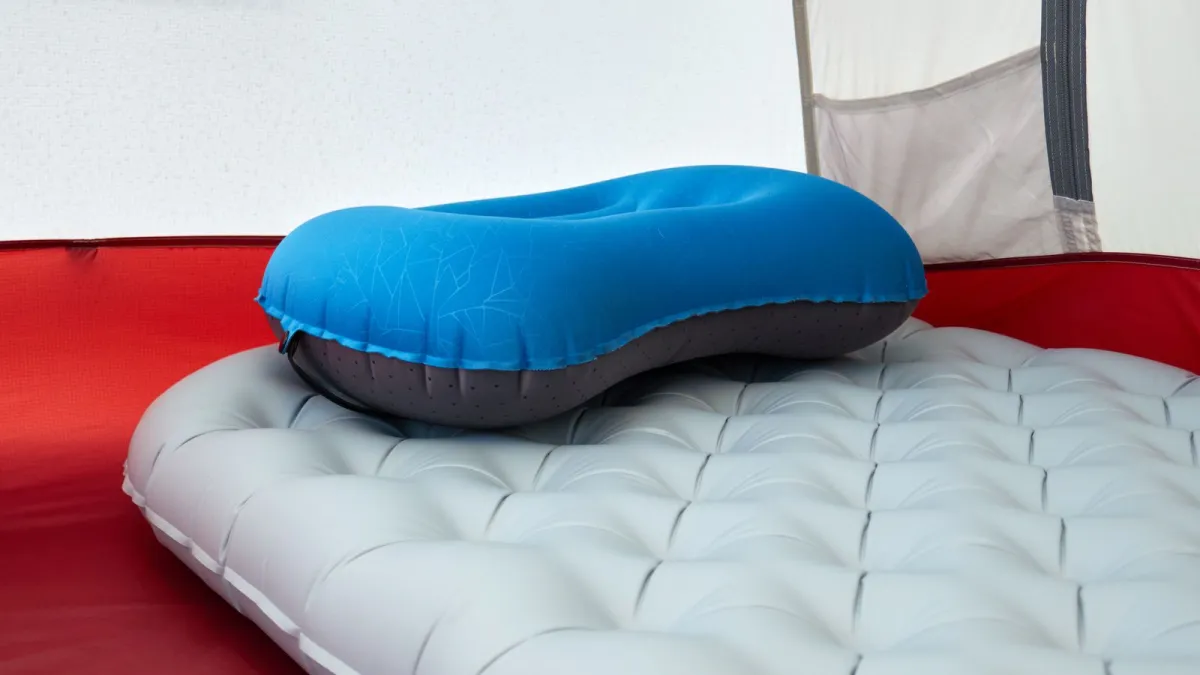
The multi-function mini valve separates it from cheap inflatables. It fills in a few breaths and lets you bleed air back out to soften the pillow without starting from flat. The exterior is a brushed knit over 50d polyester and Sea to Summit calls the material silent, since a plastic-lined pillow crinkles every time you shift.
It stuffs into a jacket pocket, so it never competes for room in a personal item bag the way a foam collar does. An inflatable is a head rest though, not a neck brace. It props your head against something solid and needs that something to exist, so a middle seat with nothing on either side leaves it with little to do.
- Packs down to pocket size and weighs almost nothing
- Memory foam top layer over the air chamber, so it doesn’t feel drum tight
- Mini valve lets you fine tune the firmness without deflating it
- Brushed knit over 50d polyester, so nothing sticks to warm skin
- Needs a window, a headrest, or a tray table to work against
- Very little sideways neck support in a middle seat
- One puncture ends its trip
- You inflate and deflate it every single time you use it
The right call for carry-on-only travelers and anyone whose last travel pillow got left at home for its size. Middle-seat regulars and forward droppers should pick the BCOZZY.
6. MLVOC Travel Neck Pillow Kit: The Budget Kit
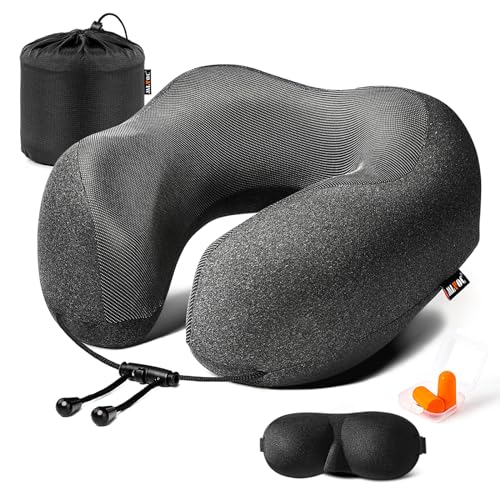
MLVOC Airplane Travel Neck Pillow for Sleeping
The MLVOC earns its slot on value alone. MLVOC is an Amazon-only seller with no manufacturer website and no support channel outside the listing. What it has is a memory foam U-shape with curved neck and chin support that ships with a 3D eye mask, earplugs and a carry bag.
The outer is a cotton blend, 65% cotton and 35% polyester, over the foam, and the listing flags it as hypoallergenic and moisture wicking. Cotton against the face beats most synthetics at this end of the market, and it’s warmer, a plus on a cold overnight cabin and a liability on a packed afternoon flight.
The kit framing is the real argument for it, since light and noise wake people as reliably as a dropped chin does. Set your expectations at that level though. The chin support is a curve molded into the foam, and there’s no brand to go back to if a seam gives out.
- Arrives as a complete kit with eye mask, earplugs and a carry bag
- Memory foam with curved neck and chin support
- Cotton blend outer feels better against the face than bare polyester
- Cotton blend outer, listed as hypoallergenic and moisture wicking
- No warranty path except an Amazon return
- Chin support is a molded curve, not an engineered overlap
- Foam is softer than the dense memory foam in the premium picks
- Bulky for what it is, and the carry bag doesn’t compress it much
The right buy for an occasional flyer who wants the whole sleep kit in one order. Frequent long-haul travelers should spend up, because this foam is softer than the dense memory foam in the premium picks.
At a Glance: The Six Pillows Compared
Picking Between the Six Shapes
Start from the failure that wakes you. If it’s the chin, BCOZZY is the direct answer and the MLVOC kit is the cheaper version of the same idea. If it’s the sideways slide, the Trtl props your head on the side it falls toward.
Then work backward from where you sleep. Upright economy seats favor the Trtl, the BCOZZY and the Aeros Premium. Hotel beds and sleeper trains favor the Cushion Lab, the only one here shaped like a bed pillow. Light sleepers who wake at every cabin announcement should look at the Ostrichpillow and accept that they’ll be warm.
Last, count the bulk, because that decides whether you keep using the thing. The Aeros Premium costs you nothing to carry. The Cushion Lab and the Ostrichpillow both need planning. The BCOZZY and the MLVOC clip to the outside of a bag and swing around while you walk. The Trtl is the one that packs flat.
FAQ
Do travel pillows help you sleep on a plane?
They help when the shape matches how your head falls. A pillow that braces your neck won’t do much if your chin is what’s dropping, and that mismatch is why so many people decide travel pillows don’t work. Get the match right and it changes how a long flight goes.
Is a U-shaped pillow or a wrap-around better?
A U-shape stops your head sliding sideways and leaves your chin unsupported unless it has a front overlap like BCOZZY’s. A wrap-around like the Trtl holds your head at an angle on one side, which suits window seats and side leaners. Neither wins in general; they fail in different directions.
How do I clean a travel pillow?
Check whether the cover comes off, because that decides everything else. Removable covers usually take a cold machine wash and an overnight air dry. Fixed covers over foam or microbeads need spot cleaning or a careful hand wash and a long dry, which is a good reason to favor a removable cover if you fly often.
Are inflatable travel pillows worth it?
They’re worth it when packing space is your real limit. The Aeros Premium packs to nothing and gives you a firm head rest to lean into, but it needs a window or a headrest to work against. In a middle seat with nothing on either side, the BCOZZY does more.
Can I use a travel pillow in a car or on a train?
Most of these work better in a car than on a plane, since car headrests sit closer to your head. The BCOZZY and the MLVOC kit move easily between a plane seat and a car seat. The Cushion Lab suits sleeper trains and overnight buses, where you can lie back and use it as a pillow.
Filed in Travel Tips