
Carl Friedrik Luggage Review: Is It Worth the Price?

This article contains affiliate links. We may earn a commission at no additional cost to you if you make a purchase through these links. See our affiliate disclosure for details. As an Amazon Associate I earn from qualifying purchases.
Carl Friedrik sells one of the prettiest hard-shell carry-ons on the market and sells it only from its own website, so there's no Amazon listing, no department store shelf, and nowhere to hand one back over a counter. That direct model is half of why the bag costs what it does, and it's also why much of the coverage you'll find comes from writers the brand sent a suitcase to.
On 19 August 2026 we read the brand's product page, the 155 first-party ratings it reports, and the owner reviews it displays, checked the spec sheet against carriers' published cabin allowances, and priced the closest hard-shell rivals you can actually buy with a Prime account. We haven't handled the bag. The Hybrid's frame, Hinomoto wheels, and lifetime warranty are the reasons to pay this price. The 14.6-inch width is the reason to pause. Away The Carry-On and the Delsey Chatelet Air 2.0 are the two Amazon bags to put beside it before you buy.
Carl Friedrik's carry-on line at a glance
The brand runs four carry-ons under one silhouette: same shape, four shells, four price tiers. The mid-tier Hybrid is the one this review is about. The product page publishes full specs only for the Hybrid and the Aluminium, so the two models we couldn't confirm are marked Not published, not guessed.
| Model | Shell | Dimensions | Capacity | Weight |
|---|---|---|---|---|
| The Carry-on (Core) | Not published | Not published | Not published | Not published |
| The Carry-on (Hybrid) | Polycarbonate with aluminium lock frame | 22" x 14.6" x 9.1" | 41 L | 9.5 lbs |
| The Carry-on X (Hybrid) | Not published | Not published | Not published | Not published |
| The Carry-on (Aluminium) | Anodised aluminium | 21.7" x 15" x 9.1" | 41 L | 10.8 lbs |
The Carry-on X is the model Pack Hacker and Carryology both chose to review, so the hands-on independent coverage of Carl Friedrik covers the Carry-on X, not the Hybrid this review is about.
What matters on a carry-on at this price
Most hard-shell carry-ons at this price already have four spinner wheels, a TSA lock, and a polycarbonate shell. The differences that matter are the closure, the wheel hardware, and how the shell takes a drop down a baggage chute.
Start with the closure. Zipped bags are lighter and cheaper to build, and the zipper is the part that fails. Frame closures, where two shells clamp shut on an aluminium rail, cost more, add about a pound, and remove that failure point. Carl Friedrik's Hybrid uses a frame with a clasp lock, which is why it weighs 9.5 lbs while the zipped Delsey below weighs 7.7 lbs. Our best carry-on luggage picks cover both closure styles at several price points.
On wheels, Carl Friedrik specifies Hinomoto 360 spinners, the Japanese wheel hardware premium luggage brands buy in rather than build. Cheaper carry-ons list "360 spinner wheels" with no supplier named, which usually means whatever wheel the factory had on hand.
Size is the other split. A carry-on has to fit a 22 x 14 x 9 inch box on most US carriers, and plenty of bags in this class run over on width because the extra inch buys packing volume.
The shell, the frame, and the leather
The Hybrid pairs an impact-resistant polycarbonate shell with an aluminium frame around the opening, so you get the flex of plastic where the bag takes hits and the rigidity of metal where it seals. Polycarbonate absorbs an impact and springs back, which is why it took over the hard-side category. Our guide to polycarbonate versus ABS luggage shells breaks down the material tradeoffs.
The leather costs money and does no work. The Hybrid's spec sheet calls it leather detailing without naming a tannage; only the Aluminium model, two tiers up, is specified as vegetable-tanned. Either way it's real hide, so it darkens and marks with use, which some people read as patina and some as damage. Delsey makes the same visual argument with vegan leather for less than half the money, so the question is whether real hide is worth the price gap to you.
Latching a frame bag shut is faster than running a zipper around three sides, and there's no tape to fray under a stuffed load. There's no expansion zipper though, so 41 litres is 41 litres forever.
Sizing: the width is the risk
At 14.6 inches wide and 22 inches tall, the Hybrid runs over the standard US carry-on box on one axis and sits exactly on the limit on the other. We haven't flown with it, so read the rest of this section as arithmetic against published allowances, not as a boarding report. Owners on the brand's own page describe it as sitting at the edge of the allowance.
The width matters on the US majors. American, Delta and United all publish 22 x 14 x 9 inches, and the shell alone is six tenths of an inch over on width and level on height before you count wheels.
Europe's budget carriers measure a different way. Ryanair's paid cabin bag is 55 x 40 x 20 cm, roughly 21.6 x 15.7 x 7.9 inches, so it's roomier on width than the US box and much tighter on depth. On Ryanair it's the 9.1-inch depth that breaks, not the width. The Away below does not fix Ryanair either. At 9 inches deep, it misses that box too. Nothing in this class clears it.
Measure the bag yourself when it arrives instead of trusting a spec sheet, since brands measure the shell and airlines measure the wheels and handle too. Our walkthrough on how to measure luggage the way airlines do takes about two minutes.
Packing, handling, and daily use
Inside, one side gets two compression straps and the other a removable compression pad, a simpler system than the dual-buckle compression panel Away builds into the bag below. The pad lifting out helps when you're packing shoes or a camera body that shouldn't be squashed, though there's no zipped divider, so the open side stays open and things migrate on a rough flight.
The trolley handle stops anywhere along its travel instead of clicking between two or three fixed heights. A two-inch miss on handle height is miserable across a long concourse, and this handle plus the Hinomoto wheels are the parts you feel on every trip.
Durability and the warranty question
Carl Friedrik covers the bag with a lifetime warranty and a 60 day return window. That warranty is the strongest claim on the product page. Two of the owner reviews on the brand's page describe a corner cracked by baggage handling and replaced free within about a week, which is the kind of after-sale behaviour that justifies a high price better than any material spec does.
Treat that rating as first-party. The 4.7 out of 5 sits on 155 reviews collected and displayed by the seller on its own site. The reviews can be real and still be a sample the brand controls. Outside the brand's page there is more to read than the direct-sales model suggests: hands-on reviews at Pack Hacker and Carryology, a public Trustpilot profile, an r/onebag thread, and write-ups at midlifeglobetrotter and allytravels. Read those before you spend, and weigh them by whether the writer bought the bag or was sent one. None of that is a large sample of verified retail purchases. A mass-market bag would have thousands of those. This one does not, which is thin evidence for the price.
- Hinomoto spinner wheels and an any-stop trolley handle, the two parts owners praise most
- Aluminium frame with a clasp lock removes the zipper, the usual failure point on hard-shell carry-ons
- Lifetime warranty backed by owner reports of fast free replacements
- Real leather detailing, not a coated synthetic
- 41 litres in a carry-on footprint, more than most bags in the class
- 14.6 inches wide: over the standard US carry-on box, so gate checks are possible
- Direct sales only, so no in-store handling and no third-party return counter
- The 4.7 average is first-party, collected and published by the brand itself
- 9.5 lbs empty, roughly two pounds heavier than a comparable zipped shell
The Hybrid makes sense if you fly full-service airlines, keep luggage for a decade, and are paying for the frame closure and Japanese wheels. It is a poor match for budget-carrier sizers. If you replace suitcases every few years, a cheaper zipper bag covers the same trips.
Consider instead: two hard-shell carry-ons you can buy today
Both ship with Prime and go back easily if you hate them, and each costs well under half the Hybrid's price. They're the two we'd cross-shop against it.
1. Away The Carry-On
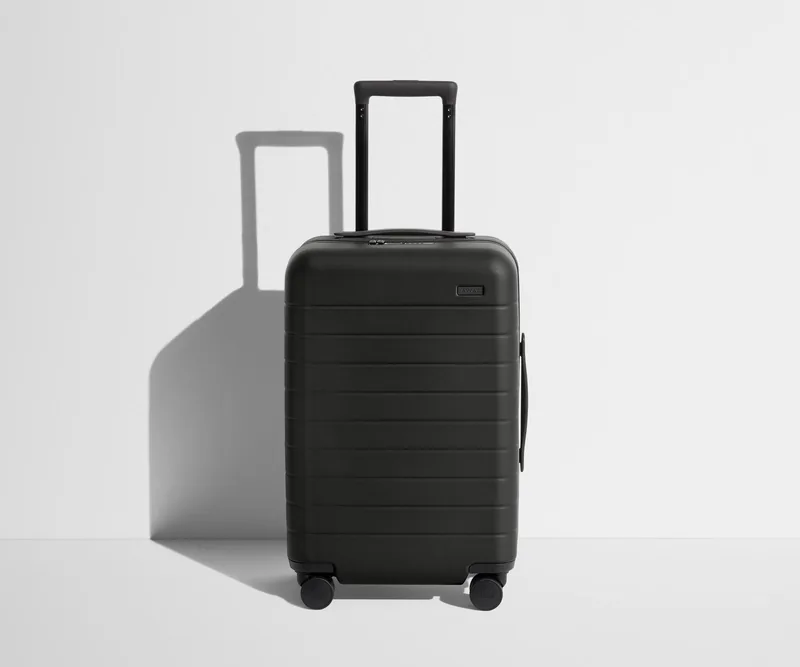
Away runs the same direct-to-consumer playbook Carl Friedrik does, then landed on Amazon through its own storefront, so returns go through Amazon's standard 30-day window. Carl Friedrik's own window is longer at 60 days. Away's advantage is the easier Amazon return, not a longer window. Polycarbonate shell, four WhisperGlide 360 spinners, TSA lock, and an exterior of 21.7 x 14.4 x 9 inches, so it fits the US box the Hybrid exceeds on width.
The packing hardware is better: the CompressMore panel is a dual-buckle plate, not a strap-and-pad setup, and it flattens a stack of clothes more evenly. You lose warranty depth and hand-feel. There is no leather, no aluminium frame, and the zipped clamshell puts the failure point back on the zipper. Our Away Everywhere Bag review covers how the brand's soft-sided line holds up over time.
- Fits inside the 22 x 14 x 9 inch box the US majors publish, so there's no sizing math to do at the gate
- CompressMore dual-buckle panel packs flatter than compression straps
- Around 40% of the Hybrid's price with the same polycarbonate shell and TSA lock
- Sold through Away's official Amazon storefront, so returns are straightforward
- Zipped closure, not a frame, and the zipper is the part that fails first
- Away's in-house WhisperGlide spinners instead of the Hinomoto hardware Carl Friedrik specifies
Away is the practical alternative to Carl Friedrik. You lose the leather and the frame, you keep the shell, the wheels, and the lock, and you fit the US carry-on box. For most travelers that is an easy yes.
2. Delsey Paris Chatelet Air 2.0
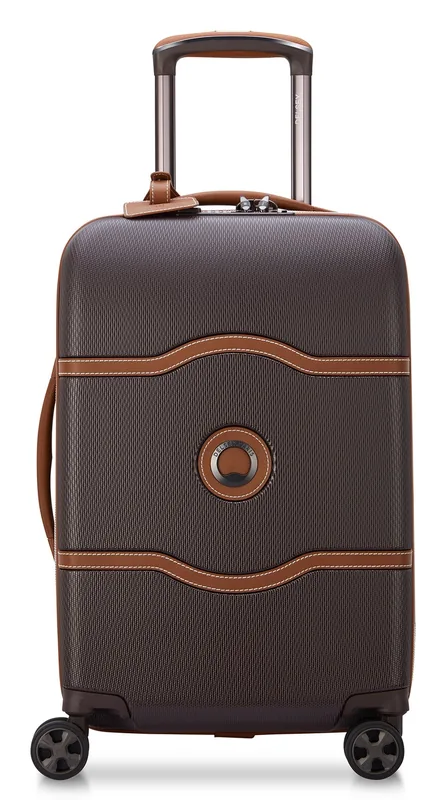
The Chatelet Air 2.0 chases the same idea as the Carl Friedrik: a hard shell dressed in leather-look trim, sold as much on looks as on how it rolls. Delsey uses vegan leather, not tanned hide, and that is the dividing line. You get the look for less than half the money, in a different material.
Spec for spec it holds up: polycarbonate with recycled content, dual-density spinner wheels, a TSA lock, and 44 litres at 7.7 lbs, roomier and nearly two pounds lighter than the Hybrid. The trim won't survive a decade the way tanned leather does. The bigger issue is a measurement mismatch. Delsey publishes 22.75" x 15" x 10" including wheels and handles, while Carl Friedrik's 22" x 14.6" x 9.1" is the bare shell, so the two sets of numbers aren't directly comparable and the Delsey is bigger on all three axes as published. Amazon also lists it as a Carry-On Plus, which is the oversized carry-on category, not the standard one. If sizing is your objection to the Hybrid, this isn't the fix.
- Closest match on Amazon to Carl Friedrik's design language
- 7.7 lbs, the lightest of the three bags here, with 44 litres of space
- Polycarbonate with recycled content and a TSA lock
- Sold as a Carry-On Plus at 22.75" x 15" x 10" with wheels and handles, so the sizing risk is worse than the Hybrid's
- Vegan leather trim scuffs and peels where real hide would patina
- Built-in USB port is a dated feature on a bag you'll keep for years
- No frame closure, so it's a zipper bag like the Away
Choose the Delsey when the Carl Friedrik appealed to your eye first. You get the look and the lightest carry weight of the three, with synthetic trim and a wider footprint.
At a glance: the Amazon alternatives
Which one should you buy?
Pick the Carl Friedrik Hybrid if luggage is a ten-year purchase, you fly full-service carriers that rarely use sizers, and you would pay for a frame closure and Hinomoto wheels anyway. The lifetime warranty makes the math work over a decade in a way it never does over two years.
Pick the Away if you want the same shell and lock in a footprint that clears the US carry-on box, and you want to spend less. Pick the Delsey if the look is what pulled you toward Carl Friedrik and synthetic trim doesn't bother you. If the urge is owning something expensive, our roundup of the most expensive luggage brands shows how far below the ceiling Carl Friedrik sits.
FAQ
Is Carl Friedrik a luxury brand?
It sits in the upper-mid tier, not true luxury. Real leather, Japanese wheel hardware, and a lifetime warranty put it above mass-market brands, while a Rimowa aluminium case costs considerably more and a Globe-Trotter or Louis Vuitton case is in another bracket entirely.
Is Carl Friedrik worth the money?
It depends on how long you keep luggage. Over ten years with a lifetime warranty behind it, we'd expect the Hybrid to cost less per trip than replacing a mid-range zipper bag twice. Replace suitcases every few years, or fly budget carriers that measure bags at the gate, and the Away covers the same ground for far less.
Is Carl Friedrik a British brand?
The name is branding, not origin: it reads Scandinavian, and third-party write-ups call the company British, though we couldn't confirm a home base or a founding story from anything Carl Friedrik publishes on its own product page, so we won't state one as fact. What the page does confirm is the business model. Carl Friedrik sells direct through carlfriedrik.com, with no retail distribution and no Amazon listing in any market we checked.
Will the Carl Friedrik carry-on fit in the overhead bin?
Go by the published numbers, not anyone's anecdote. At 22 inches tall and 14.6 inches wide, the shell sits at the height limit and six tenths of an inch over the width limit of the 22 x 14 x 9 inch allowance the US majors publish, before wheels and handle are counted. Owner reviews on the brand's page put it at the edge of the allowance, not inside it, so expect it to slide into an overhead bin without trouble, and expect it to fail a gate sizer any time an agent actually uses one.
What does the Carl Friedrik warranty cover?
A lifetime warranty on the luggage plus a 60 day return window. Owner reviews describe corners cracked by baggage handling replaced free within about a week. Warranties like this usually cover manufacturing and hardware failure, not cosmetic wear, and the leather trim marks with use.
The verdict on Carl Friedrik
Carl Friedrik gets the expensive parts right. The frame closure, the Hinomoto wheels, the any-stop handle, and the lifetime warranty are the parts that decide whether a suitcase is still rolling in 2036, and this bag has all four. Know the width risk, and know that the only rating you can see is the one the seller publishes.
Filed in Luggage Reviews