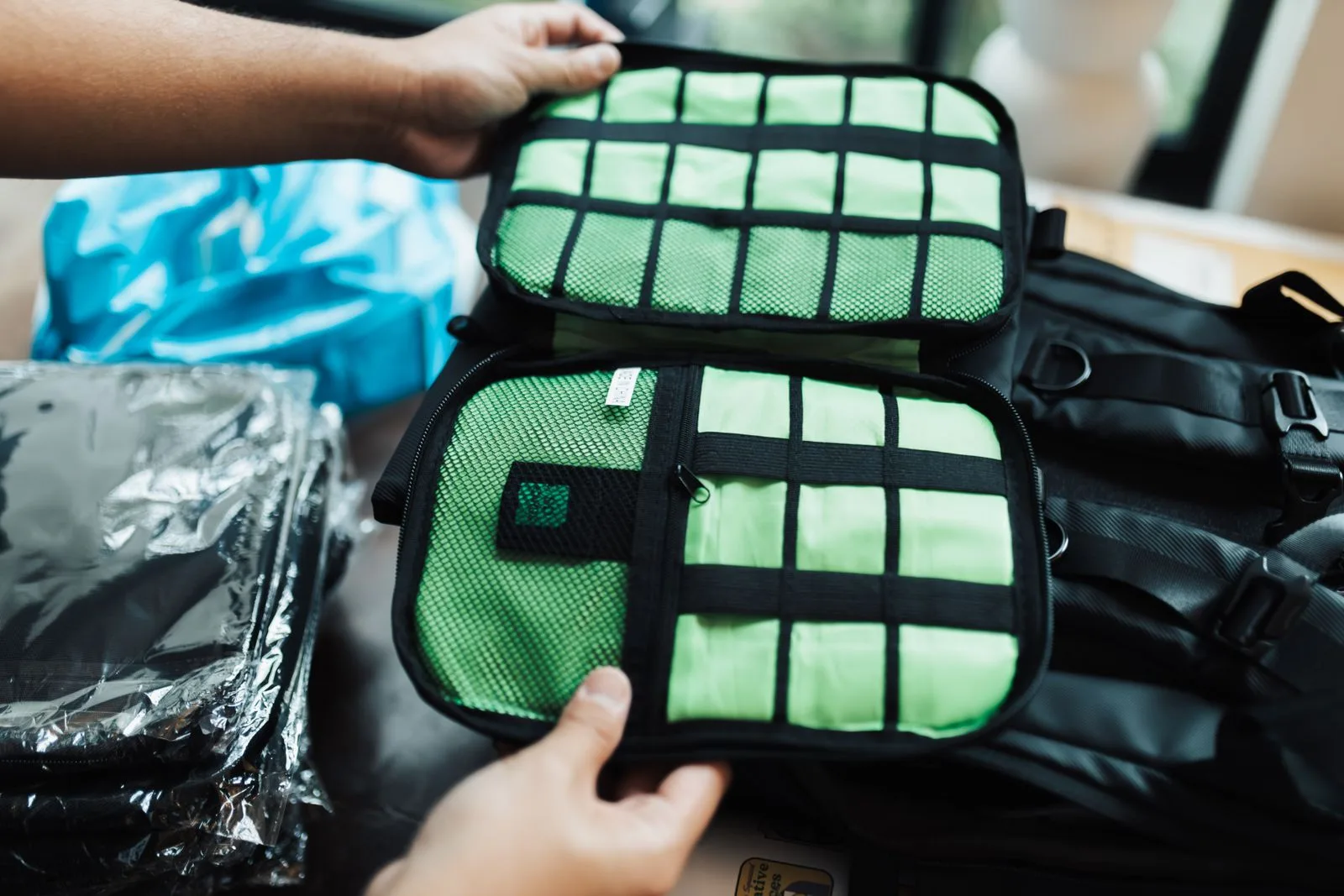
Dot&Dot Packing Cubes Review: What We’d Buy and What We’d Skip

Updated August 2026.
This article contains affiliate links. We may earn a commission at no additional cost to you if you make a purchase through these links. See our affiliate disclosure for details.
This Dot&Dot packing cubes review covers the whole line, and it lands on a clear split: the cube sets are the buy, the garment folders are a short-trip tool with one real catch, and the toiletry bag is a quiet upgrade worth a look. Everything below rests on owner footage and long-term use reports rather than brand marketing, because that is where this brand’s story actually lives.
We went through every usable owner video we could find on the line, 18 of them, spanning 2014 to 2025. One reviewer has carried her large set through more than a year of daily family trips. Another unboxed a fresh slim set on camera in 2019 and packed a three-day, carry-on-only trip with it that same day. Across every owner video found, not one shows a failed zipper, a torn seam, or broken hardware. The list of complaints owners raise is short, so where we say skip, we’re working from the handful of caveats real owners raised.
What Matters When You’re Shopping for Packing Cubes
A packing cube has four jobs: hold clothes together, survive being zipped shut when you’ve crammed it, add almost no weight of its own, and let you find things without unpacking the whole bag. Almost every difference between a set you love and a set you abandon lives in two components, the zippers and the seams. Cheap sets fail at exactly those points, usually the first time you force a full cube closed.
Weight matters more than most listings admit. A five-piece set of heavy organizers can quietly eat a pound of your allowance before a single sock goes in, so the lightest builds win by default. Visibility comes third: a mesh top panel lets screeners see what’s inside a cube at security, lets you spot the shirt you want without unzipping three of them, and keeps stored bags from going musty between trips.
Capacity honesty is where cubes surprise people: they routinely swallow more than their footprint suggests once you roll contents tightly, and three independent owners in our footage discovered exactly that. If you’re still deciding whether organizers earn their place in your bag at all, we’ve laid out the full case in our guide to whether packing cubes are worth it. And if you’re comparing this brand against the wider market, our best packing cubes roundup shows where Dot&Dot sits among the sets we rate more broadly.
The Cube Sets: The Anchor Buy
Verdict: start here, and buy the set before any other piece
The cube sets are the reason to know this brand, and the brand’s most-owned cube set is what we’d put in the cart first. Owners who have lived with these cubes the longest keep landing on the same strengths: zippers with zero failures documented across extended use, seams that stay stitched, and a build so light it never becomes the problem.
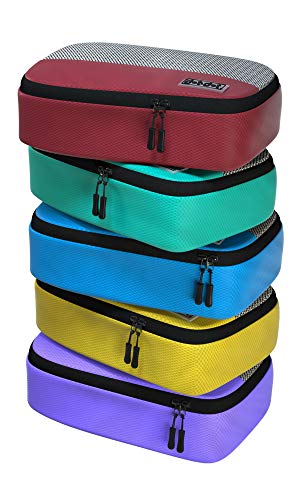
Dot&Dot Small Packing Cube Set
The anchor purchase: featherweight cubes with double zippers and see-through mesh tops, the most-owned sets the brand sells.
$27.72 on Amazon, price may vary
The durability evidence is unusually concrete for a product in this tier. A reviewer running the large cubes through daily family life reported, after more than a year, that “none of them have broken or ripped. All of the seams are still intact.” A second longtime owner says she has never had a problem with the sewing coming undone, and a third praises the stitching on her older set as absolutely even. Across all 18 transcripts, including that year-plus report, nobody documents a zipper failure, a seam failure, or broken hardware. That absence is the finding: the two parts that kill budget cubes are precisely the parts owners stop noticing on these.
Capacity runs ahead of the footprint. One motorcycle traveler counts 4 to 5 pairs of adult jeans plus 8 to 10 shirts in a single large cube, her own count from her own packing. Another zipped a cube shut over diapers, wipes, and spare outfits, and a slim-set owner discovered on camera that folded jeans fit a cube she’d assumed was too narrow.
Breathability gets steady credit, with two separate owners noting that cubes stored inside luggage between trips don’t develop the musty smell sealed fabric traps. The mesh also helps at airport screening; a longtime owner of these organizers says officers “can immediately just look and see exactly what I’ve got.”
Two smaller notes finish the case. The handles create an actual hotel routine: one owner packs the next day’s outfit into its own cube and grabs it on the way to the bathroom while full cubes go straight into the drawers. And the colorways do real logistical work: three separate households assign one color per person so cubes stop getting mixed up between family members. For squeezing air out rather than just organizing, one owner uses the double zippers to press a packed cube down like a manual compressor; if you want maximum squeeze, our guide to compression bags for travel covers the dedicated tools.
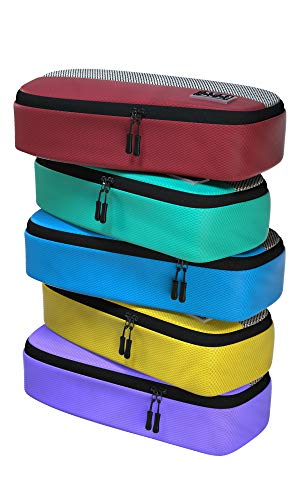
Dot&Dot Slim Cube Set
The slim set deserves its own line item because carry-on travelers pack differently. Slim rectangles slot into the dead space beside a laptop pocket and along the case walls, and one owner demonstrated a three-day, carry-on-only trip packed entirely from a slim setup. Her one caveat, repeated three times in a single video, is that an overstuffed slim cube will jam its zipper, so she keeps a finger between clothes and teeth while closing. Pack honest, zip easy. One buying note before you click: this brand’s Amazon titles drift between slim and small. Our August listing sweep pinned the slim packs to the brand’s international storefronts more firmly than to any US listing, so confirm the dimensions on whatever page you land on.
The Garment Folders: The Pieces Nobody Else Reviews
Verdict: a genuine niche tool, sized for short trips
Dot&Dot’s garment folders are the least-reviewed products in the line, and that’s not an exaggeration for effect. Only a handful of owner videos exist, none recent, and our research found no independent written review of either folder anywhere, just a decade-old sponsored blog post and reseller storefronts. If you’ve ever pulled a blazer out of a suitcase with creases pressed into it by the folds, this category exists for that problem, and almost nobody is covering it.

Dot&Dot Small Garment Folder
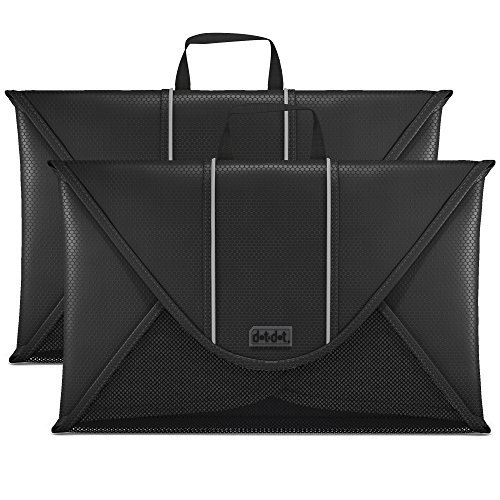
Dot&Dot Large Garment Folder
A listing warning before you click either card: Amazon has retitled this brand’s folder pages over time, and the larger folder’s ASIN currently presents as a 5-piece compression cube set on amazon.com, with the 18-inch folder title surviving on the Canadian and UK stores. Buyers on that compression-titled page have also grumbled that it doesn’t shrink a load the way true compression cubes do. Know which product you’re ordering before checkout.
The only capacity test on film came from an owner who worked through skirts, slacks, blouses, and a thin cardigan against the brand’s claim of 8 to 12 garments. Her stack reached about 10 pieces, consistent with the claim’s low end, enough for a weekend up to a week of mix-and-match outfits by her estimate. Below roughly 4 or 5 garments, though, she hit the folder’s real flaw: “it is so loose I would be worried about the items actually coming out.” Her fix is also her verdict on sizing, downsize to the 15-inch folder for short trips so the flap closes snug over a light load. That underfill looseness is the most-repeated complaint across all 18 videos, showing up in both of her folder uploads, so we treat it as structural rather than anecdotal.
Her second warning concerns airports, and it needs careful wording because it’s her judgment rather than an airline rule: “there’s no way you’re going to check this if you’re flying… but you might get away with it as carry-on.” Treat it as protection for garments riding inside your bag, and plan for the folder to travel there too. Travelers who fold rather than roll will get the most from it, since the whole point is pressing garments into a flat bundle; our rolling versus folding breakdown covers when folding wins that trade.
Skip the folders entirely if you pack light and live out of one carry-on for a week. Your shirts are already folded tight, the large folder adds a layer of fabric around clothes that were fine without it, and an underfilled folder is worse than none. Families checking a full-size suitcase with dress clothes inside are the buyer this product actually fits.
The Toiletry Bag: A Quiet Winner
Verdict: a low-risk add-on that solves the flat-pack problem
The toiletry bag rounds out the line, and both owners who filmed it liked it without qualification. Its trick is shape: one reviewer’s reaction on camera was simply, “I’ve actually never seen a flat toiletry bag.” He flagged the detail that matters most in this category, a lined compartment that separates wet items from dry ones, and called the build very light but tough.

Dot&Dot Travel Toiletry Bag
A second owner, whose kit came from the brand, showed TSA liquid bags slotted straight into the mesh compartments. We weight her footage lightly for that reason, but her layout logic holds regardless of who paid: liquids visible in mesh, the rest of the kit folded flat around them.
We’d add one caveat. The specific interior details come from those two videos alone, and neither demonstrates how the wet compartment survives a dumped shampoo bottle over months. Nobody has filmed a long-term test of this bag yet. As a companion purchase to a cube set, though, nothing in the owner record argues against it.
Dot&Dot vs Generic Cubes: What the Markup Buys
What the markup buys, on the footage, is consistency. The components that fail on cheap sets, zippers and seams, are precisely the ones owners single out on these cubes. One owner who used both brands put it directly on camera: “the quality of the dot and dot does exceed the quality of the e-bags… the seams seem to be a lot more sturdy.” She’s the only head-to-head on film, and the heavier evidence is duration: a year-plus of family use with zero component failures beats any first-impression comparison.
What the markup doesn’t buy is premium fabric. One long-term owner describes the material as thin, in the same breath as calling it great quality, and another’s only stated gripe was where the cubes are manufactured. Perceived fabric heft is where generic and branded sets feel most similar, so if you’re choosing purely by touch in a store aisle, this brand won’t always win you over.
Nobody has filmed Dot&Dot against a generic set head-to-head. What the owner record does measure is failure rate, and eighteen videos deep, the failure count stands at zero. Until a generic set documents the same stretch of ownership, paying the modest markup looks less like branding and more like insurance.
FAQ: Dot&Dot Packing Cubes
Will packing cubes add noticeable weight to my luggage?
Barely, and even a skeptic on camera came away convinced. One reviewer went looking for the weight penalty specifically and found the set “very lightweight, so that took care of that problem.” Owners don’t cite gram figures, but every owner who raises weight dismisses it.
How much actually fits in one large Dot&Dot cube?
More room than the outside implies, reliably. The most detailed on-camera count belongs to one owner who fits 4 to 5 pairs of adult jeans plus 8 to 10 shirts, and other owners independently land on the same surprise, from jeans squeezing into a slim cube to sweaters vanishing into a large with room left. Treat her count as her packing style; the extra-room pattern shows up across independent owners.
Can I machine wash Dot&Dot packing cubes, or hand wash only?
The sources genuinely conflict: one long-term owner hand washes cold and hang dries, while another treats hers as machine washable. No owner has filmed a machine cycle, so machine washing stays untested; default to hand wash cold and hang dry, and confirm against the current listing before you wash.
Can I put wet swimsuits or gym clothes back in a cube?
No, and one owner’s warning is vivid enough to quote: “you really wouldn’t want to put anything wet back in there it could ruin your whole suitcase.” Mesh breathes, it doesn’t contain water. Keep a dedicated wet bag for swimwear and damp gym gear.
Which garment folder size should I buy for a weekend trip?
The smaller folder, and the reasoning comes straight from the owner behind both folder videos. She recommends downsizing to the 15-inch folder for short trips because a lightly loaded large folder goes loose enough that garments can slide out. Snug closure beats spare capacity on a two-night pack.
How do they hold up after a year of family trips?
Better than anything else documented at this price. The one dated long-term report on film, covering more than a year of daily family use, records zero broken zippers, zero rips, and intact seams throughout. Nothing longer exists yet, so multi-year claims from any source, including us, would outrun the evidence.
The Verdict: What We’d Buy and What We’d Skip
Buy the cube set first, full stop. It’s the product the durability evidence actually describes, it solves organization and family sorting in one cart click, and the slim version extends all of it to carry-on travelers. Add the toiletry bag if your current kit bulges or leaks; the flat profile is the draw, and both owners who filmed it came away positive.
Skip the large garment folder unless checked-bag dress clothes are a regular part of your travel, and skip wet storage in any of it. Treat zip-to-compress with the same caution: Teresa Noel reaches for her zippers when she hasn’t packed a vacuum bag, not as a standing alternative to owning one, and she’s the only owner demonstrating the technique. What remains is a line with an unusual claim to make in 2026: a decade of owners on camera, and not one failure to show for it.
Filed in Luggage Reviews