Best Durable Backpacks in 2026: 6 Built to Outlast the Warranty
This article contains affiliate links. We may earn a commission at no additional cost to you if you make a purchase through these links. See our affiliate disclosure for details. As an Amazon Associate I earn from qualifying purchases.
A backpack almost never dies at the fabric. It dies at a zipper that grinds, catches, and finally splits open halfway through a trip, or at the inch or two of stitching where the shoulder strap meets the body. The panel around all of that is usually still fine. Denier is the number people shop on because it's the only one on the listing.
So we graded these six on three things at once: what the fabric survives, what the hardware survives, and what the maker will put in writing. Every spec below comes from published listing data. JanSport's fabric is ordinary school-bag polyester; the lifetime warranty is the durability claim on that one.
Durability Is Three Separate Promises
Denier measures yarn weight, the grams in 9,000 meters of thread, so 1050D nylon uses heavier yarn than 600D polyester and resists abrasion better. Weave matters as much: ballistic weaves lock the yarns in a dense basket pattern that stops a tear spreading, which is why the 1680D shell on the AMERICANPHOENIX carries the ballistic name. Our nylon versus polyester in a backpack notes put it this way: nylon takes abrasion better, polyester holds color and shrugs off sunlight. Canvas against nylon covers the natural-fibre side of the same question.
Hardware is where bags actually fail, and listings say the least about it. Zippers take more cycles than any other component, so a coil zip with self-repairing behavior (the teeth re-mesh when you run the slider back over a split) is worth more than another 400 denier of fabric. Look for bar-tacked stitching at the strap anchors, the joint carrying the load every time you swing the bag onto one shoulder. The habits that protect your luggage from damage apply here too, since a dragged and overpacked bag fails at the hardware whatever the panel is rated at.
The warranty is the maker telling you how long they expect the other two to last. JanSport's lifetime cover on a modest polyester school bag is a stronger durability claim than heavyweight tactical fabric with nothing behind it, because one of them costs the company money when the bag breaks. Materials-and-workmanship terms pay for a split seam or a dead zipper, which is exactly where bags go. Nothing covers abrasion you inflicted, so buy fabric for that part and warranty for the rest.
High denier costs you weight, and the bill arrives before you pack anything. A 1680D ballistic shell is stiffer and heavier empty than a 600D panel the same size, and it holds its box shape whether you want it to or not. Fair trade for a bag that lives in a truck, bad one for a bag that lives in an overhead bin, so choosing a backpack starts with where it spends its life.
| Fabric grade | Where you see it | What it shrugs off | What it costs you |
|---|---|---|---|
| 210D to 420D | Packable daypacks, stuff sacks, liners | Light scuffs and a passing shower with a coating on it | Almost no weight, and it wears through fast on rough surfaces |
| 600D polyester | Mainstream school and office bags | Everyday contact with clothing, desks, and car seats | Little weight, though it fuzzes and thins wherever it rubs |
| 1050D to 1200D | Work and tactical packs (the 5.11 and the Carhartt) | Gravel, concrete, and being set down hard over and over | Noticeably heavier and stiffer empty than a 600D bag |
| 1680D ballistic nylon | Heavy-duty tactical (the AMERICANPHOENIX) | Dragging, tool edges, and years of abuse in a vehicle | The heaviest fabric here, and it never packs flat |
| Laminated composites | Premium construction (the Troubadour's EPX400) | Abrasion plus water at the fabric layer, not a surface coating | Creases at the fold lines instead of draping softly |

1. 5.11 Tactical Rapid Excursion Pack: Fabric and Hardware Together
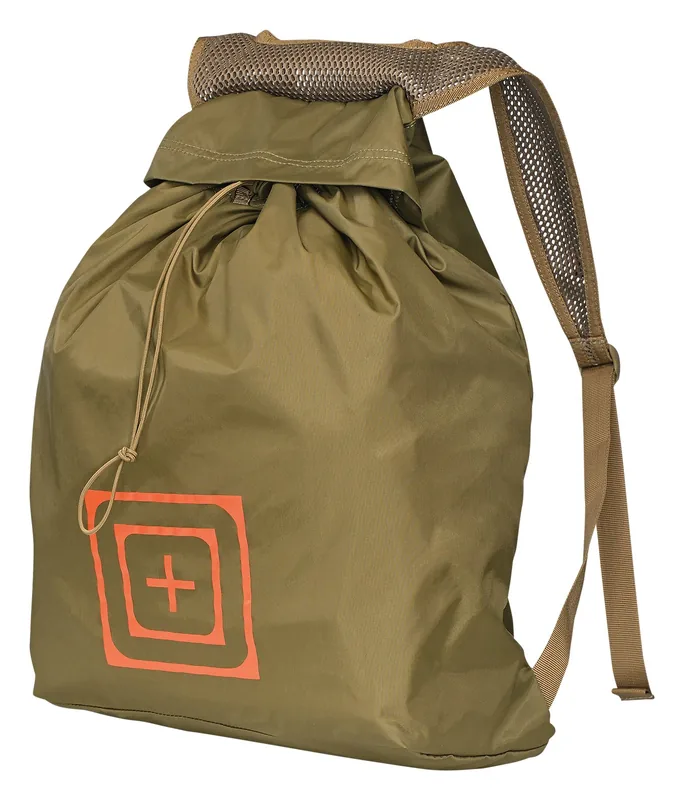
Heavy Fabric, Self-Repairing Zips
The only pick here that answers the fabric question and the hardware question in the same bag.
The listing rates this one at 1050D nylon with a water-resistant finish, a full grade above the 600D fabric on most office bags. At 23L it's a daypack, with a 20 by 12.5 inch main compartment, a front admin pocket, and a hydration sleeve. One naming wrinkle before you cross-shop: 5.11 also sells this bag as the RUSH 24 2.0 and the listing uses both names, so it's one pack under two labels.
The self-repairing zippers are why it leads. Coil zips that re-mesh when the slider passes back over a separation solve the most common way a bag stops being usable, and 5.11 puts them on a pack that already has the fabric handled. Most bags at this weight of nylon say nothing about hardware, which usually means there's nothing to say.
Organization runs to 29 inner and outer compartments including a multi-slot admin panel, more structure than most people need and also more seams and zipper runs. Wrap-around MOLLE webbing lets you hang pouches outside, which is how you get past 23L without a bigger bag.
Size is the real constraint. 23L handles a laptop, a change of clothes, and a day's kit, and it runs out well before a weekend does. It also looks tactical, which reads differently in an office than the JanSport does.
- 1050D nylon, a full grade above the fabric on most everyday bags
- Self-repairing zippers, which address the component that fails first
- Listed as water-resistant, so light rain isn't a problem
- MOLLE webbing outside, so capacity grows without a new bag
- 29 compartments including a structured admin panel
- 23L is a day's worth of space and no more
- Heavy fabric and a lot of built-in structure, so it won't be a light bag empty
- The tactical look follows you into every room
We'd carry this one if the bag has to survive daily commuting and airport floors for years. Look elsewhere if you need more than a day's capacity.
2. JanSport Cool Backpack: The Warranty Argument
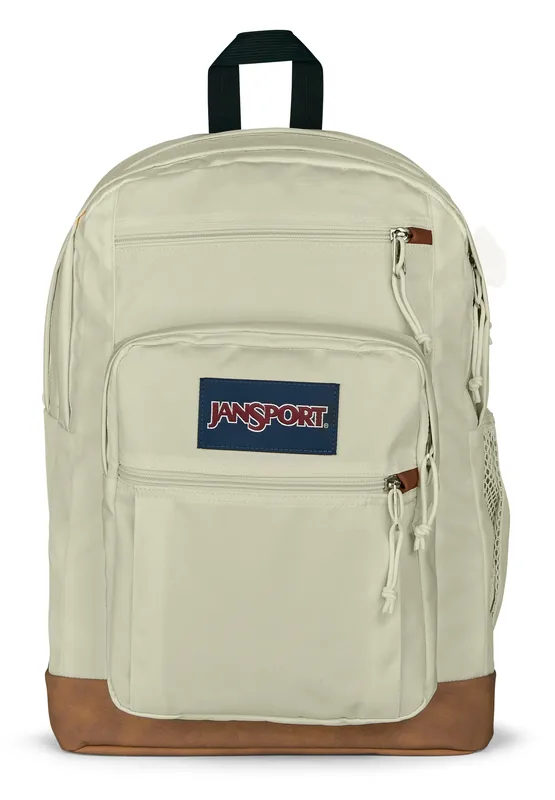
JanSport backs this bag with a lifetime warranty, and that single line does more work than any denier figure on the other five listings. The fabric is ordinary, and the listing doesn't claim otherwise. The written cover is the durability spec here, which is a strange thing to say about a school bag and still true.
The construction is modest and sensible. A leather bottom panel puts the toughest material where the bag meets the floor, the same logic Carhartt applies with a synthetic base. S-curve straps are shaped to the shoulder, and there are two compartments plus a 15-inch laptop sleeve.
What you don't get is a stated fabric grade, a weather rating, or any hardware claim. JanSport lists it as made with durable fabric, zippers, and straps, then leaves it there. Set it down on gravel daily and the fabric shows it long before the warranty gets involved.
- Lifetime warranty, the strongest durability promise in this group
- Leather bottom panel where the bag takes the most floor contact
- S-curve straps, two full compartments, 15-inch sleeve
- A front utility pocket on top of the two main compartments
- No stated denier, weave, or weather rating anywhere on the listing
- Nothing here is built for jobsite or trail abrasion
This is the budget durability pick, and the one we'd hand a student. Anyone whose bag lives outdoors should spend up on fabric.
3. Carhartt Utility 27L: Jobsite Abrasion
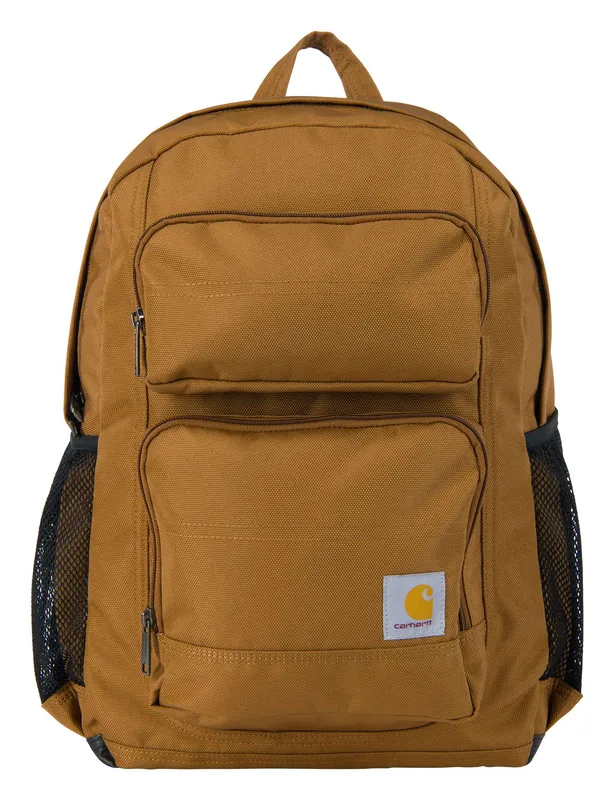
Bags that live on jobsites fail from below. They get set down on concrete and gravel a dozen times a day, and the bottom wears through while the rest looks new. Carhartt's answer is Duravax, an abrasion-resistant base panel the listing calls ultra-tough, under a 1200D polyester body with Rain Defender repellent.
1200D polyester is the interesting choice. Polyester takes abrasion slightly worse than nylon at the same denier and handles sunlight and repeated soaking better, the right trade for a bag that lives outdoors. A dedicated base covers the one spot where polyester would give out first.
Inside it's a single 27L compartment with 15-inch laptop and tablet sleeves, plus a front pocket holding four mesh sleeves and a key clip. One large space suits tools and bulky layers, and small items float around unless you use that pocket properly. The base material and the denier are the whole case for this one, and there isn't a long usage record sitting behind them yet.
- Duravax abrasion-resistant base under the exact panel that wears out
- 1200D polyester body with Rain Defender water repellent
- 27L in one open compartment, which suits bulky loads
- Dedicated laptop and tablet sleeves inside a work bag
- Polyester abrades faster than nylon at the same denier
- Single compartment means loose gear moves around in transit
- Water repellent is a finish, so it wears off with the fabric
This is the bag for gravel, concrete, and truck beds. Commuters should take the 5.11 for hardware or the JanSport for the warranty.

4. EVERKI Business 120: Durability at Travel Scale
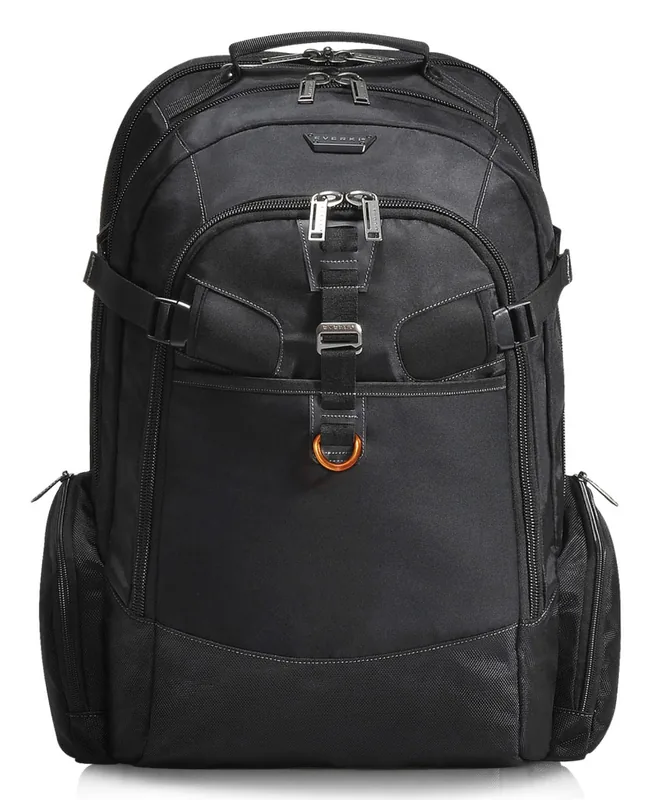
Some bags fail because the fabric wore out and some fail because they were permanently stuffed past their design. A 25L pack carrying 35L of gear keeps constant tension on every seam, splays the zipper teeth until the slider can't close them, and drags the shoulder anchors down. EVERKI's answer is structural: 40L of space, so the bag isn't fighting you.
The 5-point strap system spreads that load across more anchor points than a two-strap bag does, which matters more the heavier the pack gets. A 180 degree fold-out opening lets you pack it flat like a suitcase, and the trolley pass-through means it rides on a wheeled bag through an airport.
The included rain cover is underrated. A coated fabric handles the walk from the car; a rain cover handles standing on a platform for twenty minutes, and it costs nothing folded. The laptop compartment is padded, which matters on a 40L bag because everything else presses against it.
Nylon and polyester is all the listing gives for the shell, with no denier attached. You're buying how it carries weight. What the panel survives is unpublished.
- 40L, so the bag isn't permanently strained by overpacking
- 5-point strap system spreads a heavy load across more anchors
- Rain cover included, plus a padded laptop compartment and trolley pass-through
- No denier figure published, just nylon and polyester
- 40L is more bag than a commute needs
- Nothing stated about zipper or hardware construction
- Fold-out packing wants a flat pack, not a stuffed one
This is the structural answer to overloading, and it's the one bag here that solves the problem with space instead of fabric. Just know you're buying a carry system, because the fabric spec never arrives.
5. AMERICANPHOENIX Expandable Tactical: The Highest Denier
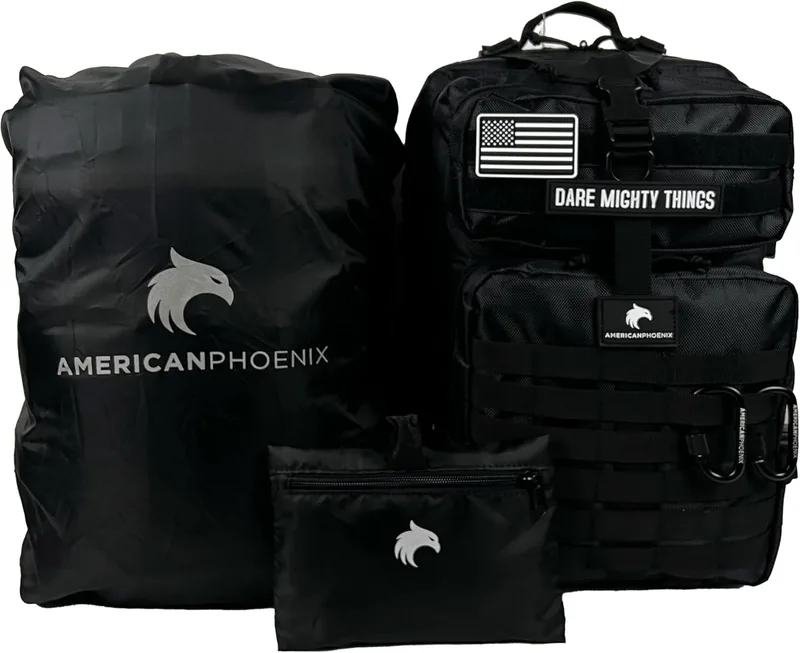
AMERICANPHOENIX Expandable Tactical
1680D ballistic nylon is the heaviest fabric here, well above the 1050D on the 5.11, and a ballistic weave holds a tear in place instead of letting it run. By the published spec, this is as much abrasion resistance as a consumer backpack offers. It's also the clearest example of what that costs, since heavier yarn means a heavier, stiffer bag empty.
Capacity starts at 45L and expands to 55L, past most carry-on allowances and firmly into checked or vehicle territory. A modular rain cover stows at the base, and a separate waterproof pocket rides inside the bag or clipped outside, a sensible way to keep wet gear off dry.
It's padded throughout, and it needs to be, because 55L of anything gets heavy fast. Heaviest fabric, largest capacity, padded construction: it's the most bag here in every sense, and nobody carries it to an office twice.
- 1680D ballistic nylon, the highest denier of the six
- Ballistic weave resists tear propagation once a hole starts
- Expands from 45L to 55L for the biggest loads here
- Modular rain cover plus a separate waterproof pocket
- Padded construction for the weight it's built to carry
- The heaviest fabric and the biggest frame of the six, so it's stiff before you pack it
- 55L exceeds most carry-on limits when fully expanded
- A ballistic shell this heavy holds its shape, so the bag never packs down
- Overtly military styling that not every setting suits
Big loads, rough handling, and no interest in packing light: that's who this is for. 1680D is wasted on a bag that lives under a desk.
6. Troubadour Apex 4.0 EPX Edition: Construction You Pay For
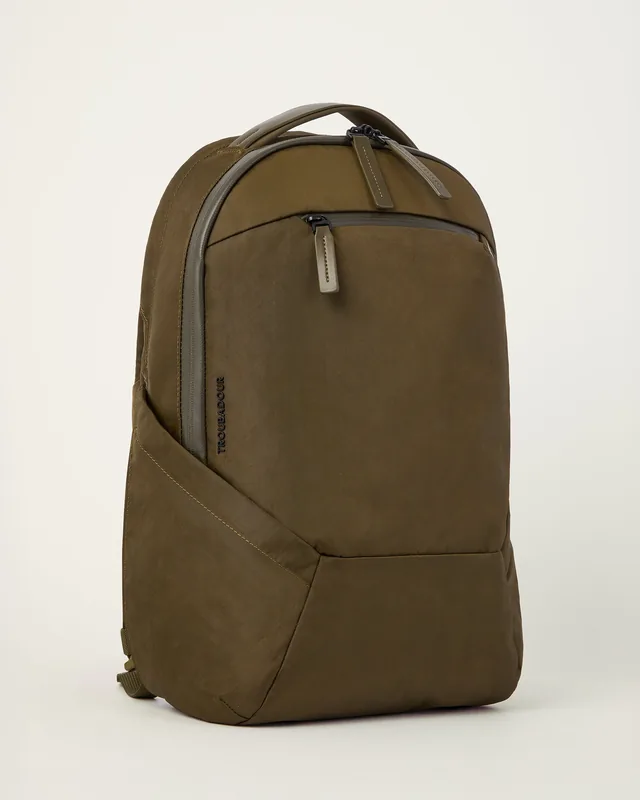
Troubadour is arguing construction over thickness. The shell is EPX400 fabric with an X-Ply reinforcement grid, a lattice of yarns laid into the material so a tear runs into a reinforcing thread instead of spreading across the panel. The fabric is fully laminated, and the listing puts water resistance at 200+ PSI hydrostatic with waterproof zippers to match. A lamination sits in the fabric layer, so it doesn't wash off the way a surface repellent does.
The laptop section is the other spec worth paying for. Troubadour calls it the CrashPad Cocoon, a suspended sleeve, so the laptop hangs clear of the bag's bottom panel. Set a bag down hard with a conventional sleeve and the machine takes that impact through the floor. It fits up to 17 inches. The face fabric is 100% recycled from post-consumer bottles and the build is PFAS-free, unusual at this water resistance since PFAS chemistry is the conventional shortcut to it. We rank recycled shells like this one in our eco-friendly backpack guide.
This bag is new enough that the long-term record doesn't exist yet. Nobody has carried one for five years, and there's no owner feedback on whether the lamination separates at the fold lines or whether the zippers stay smooth after a winter. Everything above is what Troubadour published, and it reads well. You're buying those construction specs, not years of wear.
- X-Ply reinforcement grid built to stop a tear from spreading
- Fully laminated fabric, listed at 200+ PSI hydrostatic, with waterproof zippers
- Suspended CrashPad Cocoon sleeve, so the laptop clears the bag's floor
- 100% recycled face fabric and PFAS-free construction
- Too new for any long-term durability record to exist
- 22L, the smallest capacity of the six
- Laminated fabric creases at fold points instead of draping
Take the Troubadour for the suspended sleeve and the reinforcement grid, knowing the design is unproven. Anyone who wants a written guarantee should buy the JanSport.
The One We'd Trust to Last
Start with where the bag spends its life, because that decides which promise matters. Concrete, gravel, and truck beds put the weight on fabric, which points at the Carhartt's Duravax base or the AMERICANPHOENIX's 1680D shell. Trains, offices, and airports put it on hardware, and that's the 5.11.
Then decide how much you want the maker on the hook. JanSport's lifetime warranty is the only promise here that costs the company money when the bag fails, and it sits on the plainest bag in the group.
The rest comes down to capacity. The Troubadour and the 5.11 are day bags, the Carhartt takes a work load, and the EVERKI and AMERICANPHOENIX are travel and vehicle bags. We'd carry the 5.11 for daily use, and anyone on a tight budget should buy the JanSport without embarrassment.
The Six Durability Picks Side by Side

FAQ
Does a higher denier always mean a more durable backpack?
Higher denier means better abrasion resistance, one kind of durability. It says nothing about the zippers, the buckles, or the stitching at the strap anchors, and those give out first. A 1680D bag with weak hardware fails sooner than a 600D bag with good hardware and a warranty behind it.
Where do backpacks usually fail first?
Zippers, then the stitching where the shoulder straps meet the body. Zippers take more cycles than any other component and they're the hardest thing to repair away from home. Strap anchors carry the load through a small patch of stitching, so overpacking wears them out ahead of the fabric.
What does a lifetime warranty on a backpack cover?
Materials and workmanship, so a split seam, a failed zipper, or a strap tearing loose from its anchor. It won't cover damage you caused dragging the bag across a parking lot. The warranty handles construction failures and the fabric grade handles everything you do to it.
Are self-repairing zippers worth paying for?
They're worth more than another few hundred denier of fabric, in our view. A coil zipper that re-meshes when you run the slider back over a separation turns the most common bag failure into a five-second fix. Few listings mention zipper construction at all, so a bag that names it is telling you something.
Filed in Luggage Reviews