
Dawmud Luggage Connector Straps Review: Our Verdict, Plus How to Use Them

This article contains affiliate links. We may earn a commission at no extra cost to you if you purchase through our links. See our affiliate disclosure for details. As an Amazon Associate I earn from qualifying purchases.
The Dawmud luggage connector strap does its one job well, and you should buy it knowing the brand has almost no track record. In owner demos, strapped pairs roll as a single unit, often one-handed, and the setup comes apart in seconds when you want each bag back on its own. For one person moving two rolling bags, it is small enough to keep in a suitcase pocket.
Buyer feedback for this exact listing runs just five ratings deep, so this review leans on a dozen owner videos across the main connector designs, the one long-term owner report we could find, and the TSA and airline policy pages that cover checkpoint and gate rules. Five ratings is the entire public record for this product. Treat any review of it, including this one, as provisional.
What a Luggage Connector Strap Does, and What to Look For
A luggage connector strap joins two bags so one hand can move both. Loop it through the raised handles of a pair of rolling cases, cinch it, and the pair follows like a train: "you basically can make a train out of all your luggage with these straps," as Ryan's Reviews & Tutorials demonstrated with a comparable set. Sellers sometimes call this an add-a-bag strap, and the category also covers designs that hang a tote off a bigger case.
Elastic versus woven webbing
Elastic connectors, which is the type Dawmud sells, stretch over awkward handle shapes and absorb the tugs of curbs and doorways. Woven webbing designs hold dead solid but transfer every jolt straight to your arm and the bag handles. The elastic route trades some holding power for speed and flexibility, which puts more responsibility on the buckle and on how hard you cinch.
Hardware and adjustment
The buckle is the part worth inspecting, because a cheap adjuster creeps loose exactly when a bag starts swinging. Metal hardware is what separates a serious budget strap from a toy clip: "these aren't just some plastic clips... these things are going to have a hard time breaking," the same reviewer said of a metal-clipped competitor. Look for an alloy or steel slider that grips the band and lets you tighten one-handed.
Your bags have to cooperate
Connector setups only work well with wheeled luggage, since the whole point is a stack that rolls. Similar-height bags track best; a tall checked case paired with a small spinner gets twitchy. Raise the telescoping handles only partway, because full extension multiplies the stress on them: "do not push, do not twist... that puts too much torque on this handle," warns Where Wendy Travels.
Visibility and extras
A loud color makes the stack easier to spot on a crowded carousel and cuts mix-ups. Pair the strap with personalized luggage tags so a grabbed bag finds its way back to you. Beyond that, ignore the bundle marketing: a strap pitched for quilts and moving boxes is the same band doing a simpler job.
Dawmud Luggage Connector Straps: What Buyers and Videos Show
Verdict: Handy, Cheap, and Nearly Unproven
Strapped handle-to-handle, two loaded cases roll as one unit in every owner demo we found, from hotel lobby to curb, and the setup separates in seconds when you need each bag on its own. It fits frequent multi-bag movers who want a keep-it-in-the-pocket strap. It is a weak buy if you need proven long-term durability, because almost nobody has owned this one long enough to show that yet.
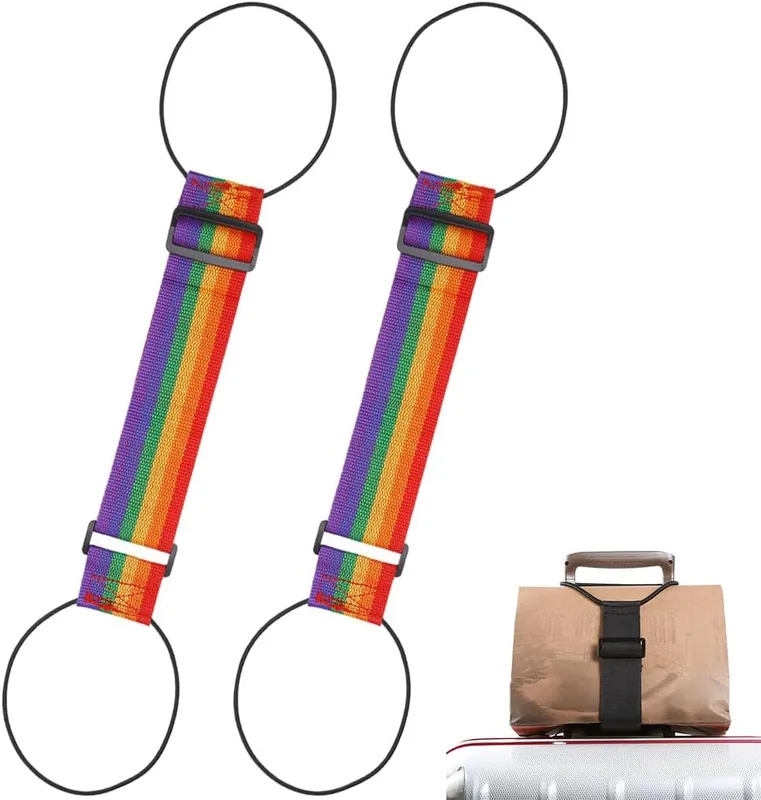
Dawmud Luggage Connector Straps
An elastic add-a-bag strap with an alloy steel buckle that turns two rolling cases into one pull: cheap, simple, and nearly unreviewed so far.
The design is one elastic band with a sliding alloy steel buckle, sold under listing model LE30267950 in a rainbow colorway that doubles as a bag finder. It folds flat and lives in a suitcase pocket between trips, which is exactly how owners of similar straps say they carry theirs: "they're small, they're tiny. I'm able to just throw it right into the front of the suitcase" (Lindsie Edgren). The metal buckle is sturdier than most hardware at this price, which usually feels flimsy.
Under strain, slack is the real issue. The band stretches when a bag swings and recovers when it settles, and the buckle hardware holds a hard cinch in every setup video we reviewed; Carlie, the one long-term owner we found, reports close to a year of use with no slack change or slippage at all. Leave a soft loop, though, and the strap walks along the handle rail. The Travelon Bag Bungee reviewer onza04 ran into exactly that: "I don't think it's secure," he said of the loose setup, until he rerouted it so "the handle is actually what keeps it on there." Two limits apply to any elastic train: it rolls only on wheels, and it stalls on carpet.
Ratings are thin: 3.8 stars across five global ratings, weighted so the split reads 54 percent five-star and 23 percent one-star, and exactly one written review exists, a short Spanish line, "Muy práctico y conveniente," meaning very practical and convenient, from a verified buyer in August 2026. The listing also contradicts itself on quantity, promising two pieces in the title while its own spec table says one, the registered brand field reads Generic even though Dawmud ships it, and there's no manufacturer warranty, only Amazon's standard 30-day return window. None of that disqualifies the strap. You are buying on how this design behaves on other listings, not on Dawmud's own history.
Longevity evidence for Dawmud itself barely exists, so the strongest datapoint we found belongs to a rival: Carlie has used a comparable strap for nearly a year without the slack changing, which speaks well of the design category and still proves nothing certain about Dawmud's webbing. The price picture is clearer. Dawmud listed it under ten dollars in August 2026, cheap enough that a miss is a small loss, and you should still check the current price on Amazon because brand-new listings move around.
Dawmud Connector Straps vs the Alternatives
| Option | What it does | Best for | Watch out for |
|---|---|---|---|
| Elastic connector strap (Dawmud style) | Links two sets of handles so one person rolls a pair | Wheeled bags of similar height | Elastic sags over time; cinch hard before each trip and route through both handles |
| Woven wrap strap | Belts a single case shut so it can't burst open | Checked bags packed to the seam | Connects nothing; adds a fumble at screening |
| J-hook add-a-bag strap | Hooks a smaller bag onto a bigger case's handle | Hanging a tote or backpack off a spinner | The free bag swings unless you anchor it well |
| Bungee-style connector | Stretches over handles in seconds | Quick moves through a terminal | Least secure option for heavy pairs |
Every row solves the same basic problem, moving more luggage than you have hands for, at very different commitment levels. Purpose-built connectable luggage like Tach's clip-together cases does the job best and costs roughly ten times more. Wrapping security straps, covered in our guide to luggage straps, solve a different problem entirely: keeping one overstuffed case from bursting open at the handlers' mercy.
How to Use the Dawmud Connector Straps, Step by Step
- Raise both handles to half height
- Loop the strap around both handles
- Pull the tail to remove slack
- Roll forward, both bags as one
The whole setup takes under a minute once you've done it twice. Owners use this sequence, adjusted for where this strap's buckle sits.
1. Stand both bags upright, wheels down, side by side, and raise each telescoping handle to half height. 2. Loop the strap around the handle of the bag you want to lead, then feed the tail through the sliding buckle so the loop cinches down on the handle itself. 3. Stretch the free end to the second bag's handle and pass it through the same way. 4. Pull the tail to remove every bit of slack, then lift the lead handle an inch off the ground; if either loop slides, retighten. 5. Roll forward slowly for the first few feet and watch the trailing bag: swinging means you need more tension. 6. To split the pair, back the slider off and slip the band over one handle, which takes seconds and no tools.
Small items riding along need extra wraps: "if you have really small items like this purse here, you may need to double up on the bottom" (Life with the Kams). And resist chaining a third bag: three-bag chains turn unwieldy fast, the one warning traveler forums repeat.
Will Airlines Allow Them? Rules at the Counter and the Gate
Yes, with conditions that depend on where you are in the airport. TSA guidance permits belts and similar accessories in both carry-on and checked bags, leaving the final call to the officer at the lane, though connector straps never appear by name in the rules. No airline treats a strapped pair as one bag, so keep the strap easy to remove and expect staff to count your bags individually.
At check-in, assume a strapped pair gets counted as two pieces, because that's how agents treat it; the r/TravelHacks threads on linking bags reach the same conclusion. If an agent asks, back the slider off and hand the bags over separately, then reconnect on the far side of the counter for the walk to your gate or train.
Gate agents are less of an issue than people expect. We couldn't find a single recorded case of a gate agent disputing connected bags, and the sizer disputes that do get filmed involve borderline bag dimensions, which vary carrier by carrier even with no strap involved. Two carry-ons strapped together still count as two carry-ons, so treat connectors as tools for rolling stacks after check-in and for hanging a personal item, not for sneaking an extra bag past a fee.
What Connector Straps Protect Against, and What They Don't
A connector strap protects your grip and your schedule. It consolidates bags so one person can move a pair through a terminal, and it stops a trailing tote from wandering off, a benefit one owner summed up as "even if somebody pulls it, aha, still attached to my luggage" (Life with the Kams).
It does not protect what's inside your bags. Behind the check-in curtain, luggage gets lifted, dropped, stacked, and dragged no matter what's strapped to it, and a band between two handles changes none of that handling. Overpacking stays risky too: a connector adds tension around handles, not across seams, so a bursting zipper remains a bursting zipper.
The strap also does nothing for security or recovery. A stretchy band is not a lock, and a determined thief defeats it in seconds. If locating a lost bag matters to you, that's a tracker's job, which is why we recommend putting an AirTag in your luggage alongside any strap. The bright colorway helps with identification only. It cuts the odds of an honest mix-up. It does not stop theft.
FAQ: Dawmud Luggage Connector Straps
Does TSA allow luggage connector straps?
Yes. TSA guidance permits belts and similar accessories in both carry-on and checked bags, with the final call left to the screening officer. Connector straps aren't named in the rules, so if an officer asks, slide the buckle open and separate the bags in seconds.
Do airlines count two strapped suitcases as one bag?
No. Every airline counts individual pieces, and Delta's baggage policy, for one, never mentions straps at all. Budget for two bag fees on a strapped pair and treat the strap as a carrying aid, not a fee loophole.
Are elastic connector straps strong enough for loaded bags?
They hold when you cinch them properly, and the alloy steel buckle feels far sturdier than the plastic clips common at this price. The trade-off is stretch: the band moves a little under load, so keeping tension matters more than raw strength. One owner of a comparable strap reported, "I haven't had any issues with the slack changing at all," after nearly a year of use.
Will a connector strap work on two different-size suitcases?
It works best on bags of similar height, which roll and track evenly. A tall checked case paired with a small spinner can work if you anchor the smaller bag tightly and keep your pace down. Expect the pair to feel twitchy on rough pavement either way.
Can you check bags that are strapped together?
You can, but check them in as the two separate pieces they are. Counter agents treat strapped bags individually, so have the strap ready to loosen or remove if an agent asks. Reconnect after the counter for the walk to your connection.
How is a connector strap different from a wrapping luggage strap?
A connector strap links two bags to each other; a wrapping strap belts a single case shut so it can't pop open. They solve different problems, and many frequent flyers carry both. If you always travel with one bag, the wrapping style is the useful one.
Final Verdict: Who Needs These Straps
The Dawmud luggage connector strap is a qualified yes. It's a simple elastic band with a metal buckle sturdier than the price suggests. Owner demos turn paired cases into one rolling unit, and teardown is seconds without loosening. It packs away small enough to live in a suitcase pocket. You are still buying a five-rating listing with self-contradicting copy and no warranty behind it, so the low price is what makes the gamble acceptable.
It helps if you juggle a checked case, a carry-on, and a laptop bag through connecting airports. It pays for itself the first time you set nothing down. Leave it if you need gear with a long ownership record, or if you never travel with two bags. Route the strap through both handles and cinch until there is no slack left.
Filed in Luggage Reviews