Peak Design Roller Pro Review: Is It Worth It?
This article contains affiliate links. We may earn a commission at no additional cost to you if you make a purchase through these links. See our affiliate disclosure for details.
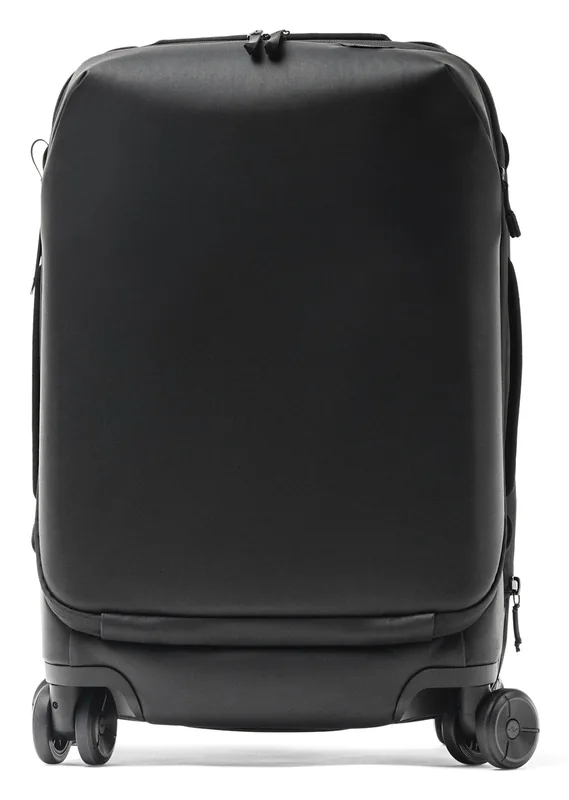
Peak Design spent a decade building camera bags before it put wheels on one. The Peak Design Roller Pro, the company's first roller bag, reads like a suitcase drawn by people who were sick of suitcases: carbon fiber trolley arms instead of aluminum tubes, a lid hinged at the front, so the bag never splits into two halves, and an interior sized around the company's own camera cubes.
On August 19, 2026 we read the published spec sheet, the long-term reviews from photographers who've flown it for months, and the live Amazon listing, then priced the two bags we'd cross-shop against it. We haven't rolled one through an airport ourselves. What follows is the spec sheet, those owner reviews, and the two bags that make more sense for most people.
What decides whether it's worth the money
The Roller Pro costs several times what a well-reviewed mainstream carry-on costs, and almost none of that premium goes into holding more clothes. It goes into the trolley, the wheels, the shell, and an interior built as a modular system you load with cubes. If you don't own camera cubes, packing cubes, or a body and two lenses that need to arrive intact, you're paying for engineering you'll never call on. Our best carry-on luggage picks cover what the same money buys when organization isn't the point.
Weight is the next filter. At 8.6 lb empty it's about a pound heavier than a good nylon softside, and it holds less: 34 liters, or 39 with the expansion zip open, against 46 in the Travelpro below. That math works in your favor only if the cubes earn the difference back in packing efficiency, which they do for camera kit and mostly don't for a week of shirts.
The shell is a hybrid, a hard structural layer wrapped in fabric. You get protection where the gear sits and an exterior that scuffs instead of cracking and gives a little when a bin is tight. Peak Design rates it water repellent, not waterproof, which is the right expectation for a walk from a taxi to a terminal.
The bag is built for terminals, taxis and hotel rooms. There are no backpack straps, no shoulder carry beyond the grab handles, and 8.6 lb gets heavy on a staircase.
Peak Design Roller Pro: what you're buying
Peak Design Roller Pro Carry-On
Check PriceThe trolley is where the design starts. Instead of the usual pair of aluminum wands, the Roller Pro extends carbon fiber arms about 0.3 inch across. Thin arms mean the housing inside the case almost disappears, so the packing floor is flat and rectangular, not ridged around a trolley channel. That's how they get the packing volume back.
The lid is the other structural decision. It's front-hinged and drops open like a drawbridge, so you never have two clamshell halves competing for floor space. In a hotel room with a bed and a foot and a half of carpet, or on a train with the case on a seat, you can open it without lifting anything. It needs headroom though: the lid swings up before it swings down, so a small aircraft's overhead bin is a poor place to go looking for your charger.
Inside, one main section takes an XL Camera Cube or Peak Design's packing cubes, the drawbridge face carries four zip pockets, a suspended sleeve holds a laptop, and the main compartment locks with a key. Four spinner wheels sit at the corners, so the bag tracks beside you rather than dragging behind. Our two-wheel and four-wheel luggage comparison covers the trade in stability.
The Roller Pro launched in 2025 and carries 41 Amazon ratings, too few to treat as a durability sample. What exists is a handful of long-term reviews from people who've flown it for months and a Reddit thread telling everyone to save their money. Any comment here on how it holds up comes from the construction and from Peak Design's backpacks, which have a stronger record.
- Carbon fiber trolley arms about 0.3 inch across, so the packing floor stays flat and rectangular
- Front-hinged drawbridge lid opens fully in a hotel room or an aisle where a clamshell can't
- Four spinner wheels, so the case tracks alongside you instead of dragging behind
- Hybrid build: a hard structural layer inside, water repellent fabric outside
- Takes an XL Camera Cube or the packing cube system, plus a suspended laptop sleeve
- 34 liters expanding to 39 through a two inch zip, and a key lock on the main compartment
- 8.6 lb empty, about a pound over a comparable nylon softside
- 39 liters fully expanded, seven liters less than the Travelpro Platinum Elite below, which costs a fraction as much
- 41 ratings so far, too thin a sample to judge long-term durability
- The drawbridge needs headroom to open, which an aircraft overhead bin doesn't give you
- The cubes that make the system work are sold separately, on top of an already premium price
This is a case for people who carry a camera and a laptop on most trips and want the case to hide that fact. The trolley, the wheels, and the drawbridge are the parts the price is paying for. If you just want a nice suitcase, 39 liters and 8.6 lb is a poor deal at this price.
Consider instead: two bags that answer the price
One does the same camera job for about half, and it has straps for days wheels don't help. The other ignores cameras and exists to show what a normal carry-on costs.
PGYTECH 2-in-1 Roller Camera Backpack
PGYTECH 2-in-1 Roller Camera Backpack
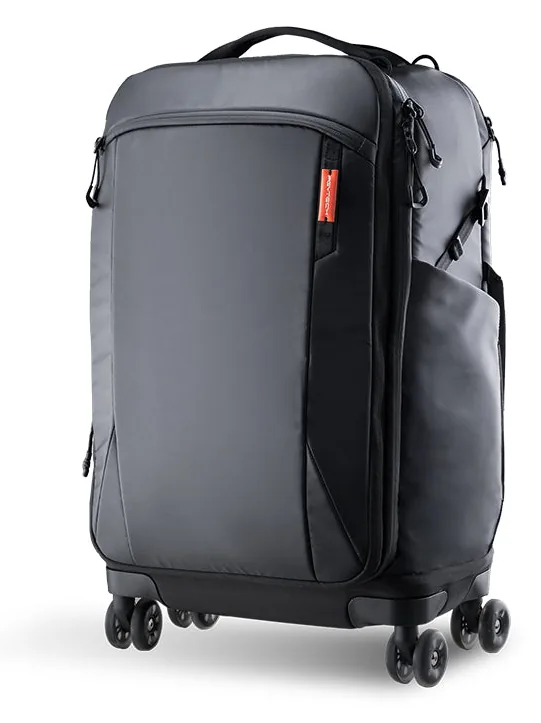
The PGYTECH is the direct counter-argument. It rolls on spinner wheels like the Peak Design, protects camera bodies and lenses like the Peak Design, and then it grows backpack straps, which the Roller Pro can't do at any price. Regional trains, old-town streets, and apartment stairs are the days that conversion is for. The front compartment expands to about 10 liters, a 16 inch laptop fits, and the box includes a rain cover, a digital organizer pouch and a tripod attachment. Our roundup of wheeled backpacks for travel covers how that conversion tends to hold up.
Hardware is where the savings come from. The dividers are fabric and velcro, adjusted with your hands inside the bag, instead of cubes you lift out whole and drop into another bag. There's no carbon fiber anywhere, so the trolley is a normal telescoping handle with normal flex. It carries 77 ratings, a thin sample too, though PGYTECH has been shipping camera gear for years.
- Converts between spinner roller and backpack, the one thing the Roller Pro can't do
- Roughly half the price for the same core job of moving camera gear on wheels
- Expandable 10 liter front compartment plus a 16 inch laptop slot
- Rain cover, digital organizer pouch and tripod attachment in the box
- Velcro divider system, adjusted by hand inside the bag
- Standard telescoping handle, with the flex that comes with it
- 77 ratings, so long-term durability is still an open question
For photographers who travel by train more than by plane, this is the one. It gives up the Peak Design's build quality and the modular cube system in exchange for straps, half the price, and an easy time on stairs.
Travelpro Platinum Elite Carry-On Spinner 21"
Travelpro Platinum Elite 21
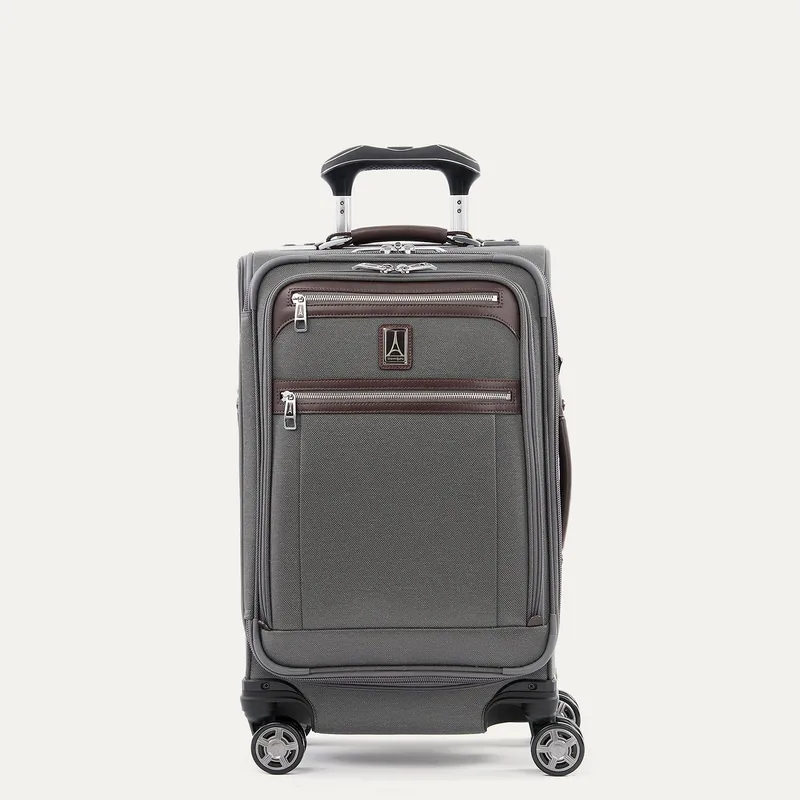
Set it next to the Roller Pro and the numbers are lopsided. It's lighter at 7.7 lb, holds 46 liters against 39, and sits well under the Peak Design on price. It also has more than 4,000 Amazon ratings behind a 4.5 average, which is the only durability record in this article large enough to lean on. Peak Design is working from 41 ratings.
The nylon softside build has eight spinner wheels, a TSA combination lock, an expansion zip, a built-in suiter for a jacket, nine pockets and tie-down straps. It's been the default recommendation for flight crew for years, and boring consistency is the reason. For camera gear it does nothing. There's no padding, the interior has no dividers, and there's no cube system, so lenses travel in whatever case you already own. If the camera cubes are not why you opened this review, this is where the money should go instead.
- More than 4,000 ratings at a 4.5 average, the only large durability sample here
- 46 liters against the Roller Pro's 39, at 7.7 lb, not 8.6
- Eight spinner wheels, TSA combination lock and an expansion zip
- Built-in suiter, nine pockets and tie-down straps for clothes-first packing
- A fraction of the Peak Design price, sold and shipped by Amazon
- No camera protection or modular organization of any kind
- Soft nylon exterior, so nothing but your own packing protects the contents from a crushed corner in a bin
This is the reference point every premium carry-on has to beat, and most don't. Get it when the camera cubes were never the reason you were looking.
Which one should you buy?
The Roller Pro makes sense if you already live in the Peak Design system, or you're about to. The cubes are what turn a heavy 39 liter suitcase into a camera case that doesn't look like one. Go in knowing owner ratings are still thin and the cubes cost extra, and settle the organization question first with our take on whether packing cubes are worth it.
The PGYTECH is for travel days full of stairs, trains and streets that eat wheels. Half the money, straps when you need them, and a divider system that does the job with less finesse. The Travelpro is the one to grab if you're moving clothes, not camera glass. It's lighter, roomier, far cheaper, and thousands of owners have already tested it for you.
FAQ
Is the Peak Design Roller Pro worth it?
It's worth it for photographers and creators who'll fill it with camera cubes and fly often enough to notice how it rolls. The carbon fiber trolley frees real interior volume, four spinner wheels let the case roll at your side, and the drawbridge lid opens in places a clamshell can't. For a traveler packing clothes, it's a heavy, small, expensive carry-on and the answer is no.
How big is the Peak Design Roller Pro?
It measures 21.8 x 14 x 9 inches and weighs 8.6 lb empty. Capacity runs 34 liters closed and 39 with the two inch expansion zip open. Those closed dimensions sit right at the edge of the common 22 x 14 x 9 inch US carry-on allowance, with almost nothing to spare.
Does the Peak Design carry-on fit airline size limits?
Closed, it fits the 22 x 14 x 9 inch box that American, Delta, United and the other US majors publish, though only barely. International carriers and European budget airlines often set a smaller box and weigh the bag as well, so check the airline's own figures before you fly. Expanded, the bag grows past the standard box, so treat the expansion zip as something you open in a hotel room rather than at the gate.
Does the Roller Pro fit a camera and a laptop?
Yes. The main compartment is built around an XL Camera Cube, which handles a body with two or three lenses, and a suspended sleeve takes a laptop separately. The cubes are sold on their own, so budget for them as part of the purchase price.
What colors does the Peak Design Roller Pro come in?
Peak Design sells it in a small range including Eclipse, Black and Sage, all at the same price with the same construction. Stock moves around by colorway, so the shade you want may not be the one available on any given day. Check the live listing before deciding a color is a dealbreaker.
Is the Roller Pro waterproof?
The shell sheds rain. It is not waterproof. The fabric exterior and the hard inner structure add a second barrier, enough for rain on the way in from the curb. Standing water and a long downpour are a different question, and expensive camera gear deserves a dry bag inside the cube if the forecast is bad. Our guide to polycarbonate versus ABS luggage shells explains why the material under the fabric matters more than the finish on top.
The verdict on the Roller Pro
Peak Design built the suitcase it wanted to exist, and most of the unusual decisions are correct. Carbon fiber arms buy back packing space, four corner wheels let the case track beside you, and a front-hinged lid opens in rooms where a clamshell needs floor space. It still holds 39 liters, weighs 8.6 lb, and has 41 owner ratings. That is a specialist bag at a specialist price. If you own the cubes and the glass, nothing else here comes close. If you don't, the Travelpro holds more for less and the PGYTECH does the camera job for half.