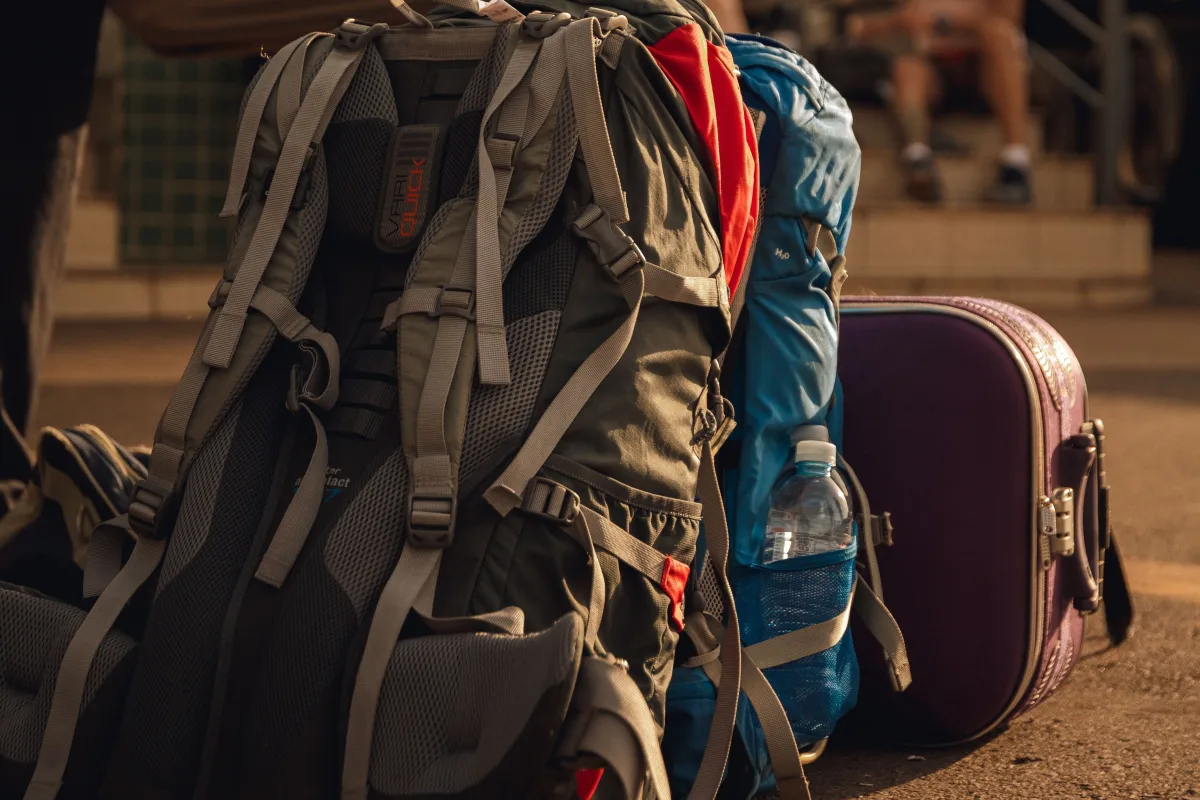
Can You Check a Backpack as Luggage?

Yes. You can check a backpack as luggage. American and Delta publish standard economy limits of 62 linear inches and 50 pounds. Secure the straps and hipbelt so they don't snag the belt, and remove power banks and spare lithium batteries before it leaves the counter.
The size rules below come from American's and Delta's checked-bag pages, and the item rules come from TSA and the FAA. Before the counter, stow the harness, clip the hipbelt around the pack, or put the whole backpack in a protective duffel so loose webbing can't catch on the baggage system.
Buying one? How Late Can You Check Into a Hotel? (Complete Guide)
The size and weight box is the same as a suitcase
A backpack has to meet the same checked-bag box as a spinner. American and Delta publish a standard limit of 62 linear inches (length plus width plus height) and 50 pounds in economy. The shape of the bag doesn't get you a pass.
American's checked-bag policy sets 62 in / 158 cm and 50 lbs / 23 kg in economy. Delta's baggage overview uses the same 62-inch (157 cm) and 50-pound box. The fee depends on your fare, route and status, so price the bag on your booking; we work through that math in carry-on vs. checked bag.
| Airline | Checked size | Economy weight | Source |
|---|---|---|---|
| American | 62 in / 158 cm (length + width + height) | 50 lbs / 23 kg | Checked bag policy |
| Delta | 62 in / 157 cm | 50 lbs / 23 kg | Baggage overview |
Measure the packed bag, not the empty listing. A stuffed front pocket, a bottle sleeve, and hanging straps all count if they stick out. The arithmetic is the same one we walk through for 62 linear inches: add the three outside sides and stop at 62 unless you're ready to pay an oversize fee.
A liter rating alone can't establish the bag's exterior size. Measure the fully packed bag and weigh it at home against the limits for your flight; our guide on how to measure a backpack for airlines covers the pockets and straps that add inches.
What the belt does to a pack
Checked bags ride conveyors, chutes, and carts. A spinner presents a hard shell and a handle. A backpack presents webbing, foam, and zippers on the outside.
Loose shoulder straps and hipbelt wings can catch on baggage equipment and damage the harness. A rain cover alone can tear and leave the straps exposed.
That's why securing loose straps matters even when the backpack meets the airline's size and weight limits. Enclosing or stowing the webbing reduces its exposure to baggage equipment.
How to prepare the pack at the counter
Prepare the pack at home before you reach the counter. Follow the checklist below, then check it bare if the harness zips away or bag the whole pack.
- Dump water. A half-full bottle adds weight and can leak onto clothes once the bag is on its side.
- Take out power banks, spare camera batteries, and anything else with an uninstalled lithium cell. Those stay in the cabin. If a laptop or camera with an installed battery goes in checked baggage, the FAA requires it to be completely powered off and protected from accidental activation and damage. Keeping it in the cabin also reduces its exposure to damage or theft.
- Clip the hipbelt around the pack, or stow the wings in their pockets if the pack has them. Don't leave the belt hanging like a second handle.
- Shorten the shoulder straps and either zip them under a back panel or buckle them across the front of the bag so nothing dangles.
- Tuck sternum straps, load-lifters, and ice-axe loops. Zip every pocket. Pull the compression straps tight, then tuck in the loose ends.
- Put the luggage tag on a haul loop or grab handle so it stays attached if loose webbing tears off. If you use a tracker, bury it in an interior pocket.
- Weigh the packed bag. If you're close to 50 pounds, pull shoes or a jacket into the cabin bag. Measuring the three sides is the same method as how to measure luggage: outside, packed, nothing compressed.
Duffel, wrap, or a zip-away harness
You don't need a special "backpack cover" under the checked carrier rules cited above. You do need to secure anything that can snag. Three ways to get there:
Zip the harness away. A lot of travel packs hide the shoulder straps and hipbelt under a zippered back panel. That keeps the harness enclosed during handling. Osprey's Farpoint and Fairview line is one example, and our Osprey Farpoint 55 review covers how that pack's harness zips behind a panel.
Put the whole pack in a zip duffel. This works for a hiking pack with a rigid hipbelt you can't fold around the bag. The duffel encloses the webbing and adds a grab handle. Measure the packed backpack before choosing the duffel, and leave enough room to close it without compressing the pack.
Airport plastic wrap, or a rain cover plus a luggage strap. Wrap only after the straps are already tight. Wrap over a loose harness and the plastic can become another snag if it rips. A luggage strap around the middle can help keep a rain cover in place. Ask the airline or airport whether it provides a protective bag for odd-shaped luggage.
What has to come out before the bag goes on the belt
The backpack is allowed. Several items people keep in backpacks aren't, at least not in the hold.
TSA's power-bank page says carry-on yes and checked bags no. Spare lithium batteries, including power banks and phone charging cases, are prohibited in checked luggage. FAA PackSafe repeats that and adds the gate-check rule: if a carry-on later goes down to the hold, the spare lithium and power banks still have to come out and stay with you in the cabin. Terminals need to be protected from short circuit (tape, a sleeve, or the retail pack). The watt-hour limits for the cabin are in our guide to taking a power bank on a plane.
Installed batteries in a laptop, phone, or camera follow a different FAA rule. If checked, the device must be completely powered off and protected from accidental activation and damage. The FAA recommends keeping these devices in carry-on when possible.
| Item | Checked pack | Cabin | Source |
|---|---|---|---|
| Power bank / spare lithium | No | Yes, with Wh limits | TSA Power Banks; FAA PackSafe |
| Laptop or camera with battery installed | Allowed if completely off and protected from activation and damage | Recommended | FAA portable electronic devices with batteries |
| Fuel canister or liquid fuel | No | No | TSA What Can I Bring |
| Camp stove | Only if empty and cleaned of fuel vapors | Same | TSA What Can I Bring |
| Hiking poles, sharp tip | Yes, wrap the tip | No | TSA What Can I Bring |
| Tent stakes | Yes, sheathed | No | TSA What Can I Bring |
Buy fuel at the destination. TSA lists butane, propane and flammable liquid fuel as banned from both checked and carry-on bags, and a camp stove can travel only if it's empty of fuel and cleaned so no vapors or residue remain.
Counter check versus gate check
Both end in the hold. Counter check is the planned version: you pay, you get a destination tag, the pack goes downstairs. Gate check is the last-minute version, usually because the bin is full or the regional jet has no overhead space. FAA PackSafe still wants the power banks out of a bag that gets tagged at the jetway, and our gate-check routine lists what else to pull before you hand it over.
Gate-checked bags may come back at the jetway on some routes, but don't count on that. Tag the pack as if you'll next see it in baggage claim.
Put a tracker in an interior pocket if you're using one. We have a separate page on using an Apple AirTag for luggage. Keep the external luggage tag on a secure grab handle.
Keep one bag with you
A checked bag and a cabin allowance are separate parts of the fare. Check what your ticket includes. If it includes a personal item, a smaller backpack can fill that role when it meets the carrier's under-seat rule. We cover the cabin combination on carry-on and a backpack.
Use that cabin bag for the lithium, the passport, the medication, and a change of clothes. The hold is where packs disappear for a day. A 65 liter bag full of a week of hiking clothes is a miserable thing to lose if the only spare shirt is also in it.
If the pack comes back scuffed
Soft bags can return with scuffed fabric, torn webbing, or damaged zipper pulls. Photograph the pack at the counter if you can, and go to the baggage office before you leave the airport if a haul loop is torn or a frame stay is bent. Check the carrier's damage terms; our related guide covers lost or delayed luggage compensation.
FAQ
Can you check a backpack as luggage?
Yes. American and Delta apply the same standard economy size and weight limits to a backpack as to other checked luggage: 62 linear inches and 50 pounds on the policies checked here. Secure the straps and remove power banks and spare lithium batteries first.
Do I need a cover or a duffel?
No. The checked carrier rules cited above don't require a backpack cover. Secure the harness so it can't snag. A zip-away harness, a protective duffel, or wrap over already-tight straps can do that.
Can I check a 70 liter hiking pack?
Yes, if the packed pack meets your carrier's checked size and weight limits. A 70-liter label alone can't establish that. Measure and weigh it packed. Put it in a duffel if the hipbelt is rigid and won't clip around the bag.
Can I leave a power bank in the pack?
No. TSA bans power banks and spare lithium in checked bags. FAA PackSafe says the same, including when a bag is gate-checked. Keep them in the cabin, terminals covered.
Can I check a backpack and still bring a personal item?
It depends on the ticket. A checked-bag allowance and a cabin allowance are separate. A small backpack can serve as the personal item when the fare includes one and the packed bag meets the carrier's under-seat rule.
Will the airline charge extra because it's a backpack?
The carriers cited above apply their standard checked-bag, oversize, and overweight terms. The price depends on your fare, route, size, and weight. Confirm the current amount on your booking.
Filed in Travel Tips