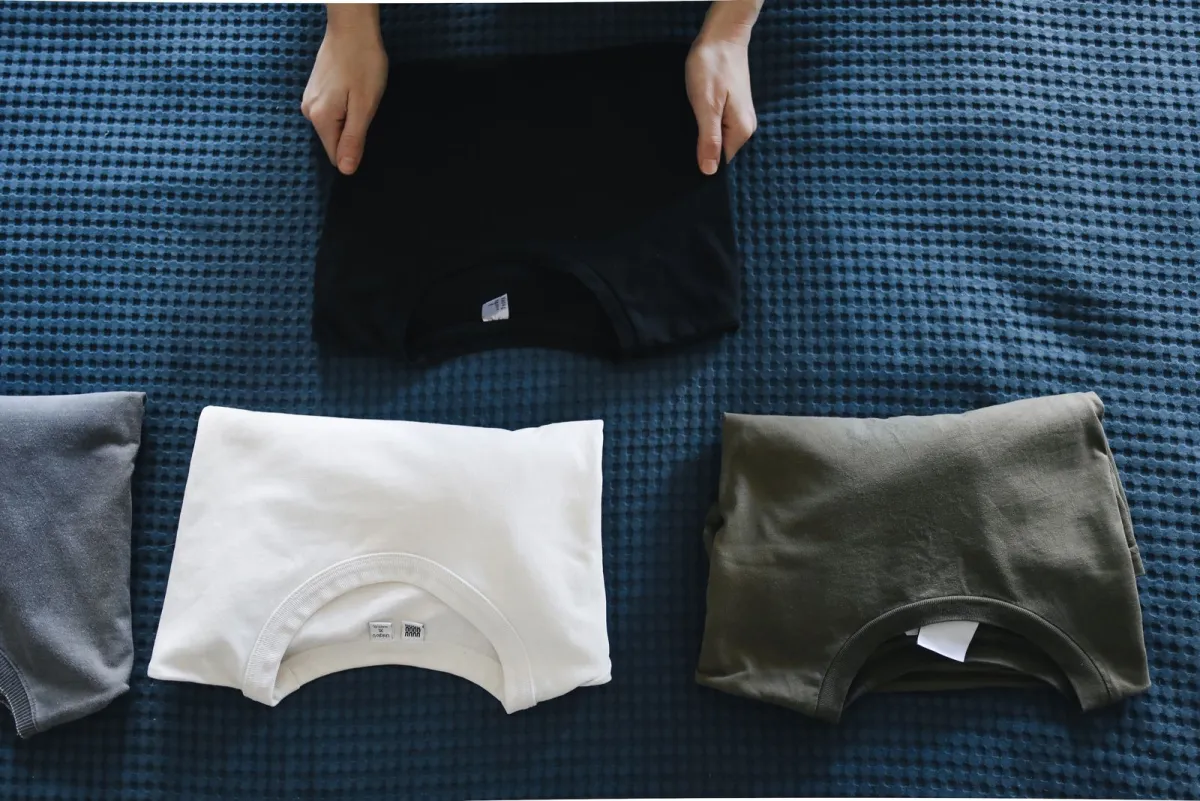
File Fold Packing: Stand Clothes Up Like Files

File fold packing is a KonMari-style vertical fold. Each garment becomes a small rectangle, then stands on its edge in a packing cube or against a suitcase lid so every item shows like a file in a drawer. You can pull one shirt without unpacking the stack.
Marie Kondo's folding is the source. We call it file fold packing when the drawer is a suitcase. Cubes hold the files. The fold still works if all you have is a lid to lean them against.
Buying one? The Ranger Roll: How to Pack Clothes Tight Without Wrinkles
What is file fold packing?
File fold packing turns each garment into a rectangle that stands on its edge. The row faces you in a cube or against a suitcase lid, so every shirt is visible and taking one out doesn't collapse the rest. Marie Kondo's fold is that motion.
A stacked fold is the same rectangle laid down in a pile. You see the top shirt. Everything under it is a guess, and the shirt at the bottom takes the weight of the pile. File fold rotates that rectangle 90 degrees and uses the cube's depth as a drawer.
The packet has to be tight enough to stand on its own. If it slumps, the last fold was too loose, or you skipped the small gap at the edge that keeps the final crease from turning into a thick wedge.
File fold vs ranger roll vs a stacked fold
A stacked fold is the housekeeping rectangle: hem toward collar, pile on pile. It's fast. It hides every shirt but the one on top, and the bottom shirt lives under a crease for the whole trip.
A ranger roll is a tight cylinder with a tucked cuff. On the same t-shirt it usually takes less volume than any fold, because the roll squeezes leftover air. That's the method to use when the zipper is the problem.
A file fold is the stacked rectangle stood on its side. You give up some of the roll's density. You get a row you can read. The rolling vs folding clothes page treats folding as the move when you have to live out of the bag.
Wrapping a whole outfit around a socks-and-underwear core is a different method. File fold is one garment, one file. Don't mix them in the same cube or the row stops reading as a row.
How to file fold a t-shirt
- Fold one side toward the center
- Fold the other side the same way
- Fold in half, leave a small gap
- Fold in half to match the wall
- Stand the tee on its edge
Start with a short-sleeve tee on a table, face up, smoothed flat. The steps below follow Marie Kondo's own fold for tees on KonMari's folding guide. The small gap she asks for keeps the last fold from building a thick edge that makes the packet flop.
- Fold one side toward the center so you have a straight edge, about a third of the shirt's width.
- Fold the other side the same way. You should have a long, even rectangle with the sleeves inside the edges.
- Fold that rectangle in half along its length, and leave a small gap at the edge instead of lining the hem up flush. That gap is what lets the last fold sit without a bulge.
- Fold in half or in thirds, whichever height matches the cube or the lid well you're packing into. The finished packet should be slightly shorter than that wall.
- Stand the tee on its edge. If it falls, unfold the last step and fold it tighter, or take one more fold so the packet is smaller and thicker.
A packet that stands on a table will stand in a cube. A packet that needs your hand to stay up will fall the first time the suitcase moves.
Long sleeves
Fold one side toward the center, then fold the sleeve back so it sits inside the rectangle's width, then fold the extra sleeve length flush with the rectangle's edge. Do the same on the other side. From there the tee steps take over: fold in half along the length with a gap, fold to height, stand it up.
A polo or an oxford uses the same motion. Button it first so the placket stays in a straight line. A ranger roll curves that placket around the cylinder. File fold keeps a flat front, so collared shirts belong here if you care how they look when you pull them out.
How to file fold pants
Button or zip the pants. Lay them flat. Marie Kondo's pants fold is shorter than the shirt fold because you already have a long rectangle.
- Fold one leg over the other so the pants are a single panel. Smooth the crease.
- If the crotch sticks out past the hip, fold that triangle in so the long edges are straight.
- Fold the legs up toward the waistband and leave a small gap at the edge, the same gap as the shirt fold.
- Fold in half or in thirds until the packet is the height of the cube or the lid well.
- Stand the pants on their edge. Jeans stand if the packet is tight. Thick denim may need one extra lengthwise fold so the packet isn't too wide for the cube.
Shorts are the same fold with fewer steps. Fold the legs together, fold to height, stand them. Underwear and socks can file-fold too, but in a suitcase they often do more good filling leftover gaps than occupying their own row.
How to stand the files in a cube or a suitcase lid
A packing cube is the easiest drawer. Stand the packets so the edges face the mesh lid. Zip the cube while they're still standing. If you own no cube, open the suitcase and stand the files against the lid well or the center divider. The lid is the back of the drawer.
Cubes are a container. They are not the method. Buy a set when you want the zip to keep the row from falling over after the bag shuts. That decision sits on are packing cubes worth it. Skip the cube if the bag is a duffel with no face to stand against. File fold needs a wall.
Do the check on your own table: four file-folded shirts in a row, the same four shirts in a flat stack, tape on both. Those two heights are the comparison. The file row also shows every shirt. The stack shows one.
Pack shirts in one cube or one lid well, pants in another. Mixing tees and jeans in the same row makes the packets different heights, and the short ones fall into the gaps.
When file fold packing is the better method
File-fold collared shirts, polos, and anything you'll pick by sight on day three. Ranger-roll t-shirts, gym clothes, and knits when the zipper is the problem. Jeans can do either. A thick sweater eats cube height; roll that one, or put it in a compression bag for travel, if bulk is what won't close.
The ranger roll still wins on leftover corners and on a weekender that has to swallow a weekend of knits. File fold wins in a cube you'll live out of, and on shirts that should come out looking like shirts. Putting every garment through one method is slower than matching the fold to the fabric.
If the bag is a personal item with no lid well and no cube, roll. File fold with nothing to lean on is just a stack that fell over.
Fold four shirts and stand them
Fold four shirts, stand them in a row, and see whether you can find the one you want without touching the others. If that row is the point of the bag, file fold is the method. If the zipper still won't close, roll the knits and keep the files for the shirts that have to look like shirts.
FAQ
What is file fold packing?
File fold packing is Marie Kondo's vertical fold used in a suitcase. You fold each garment into a small rectangle, then stand it on its edge in a cube or against a lid. The row reads like files in a drawer, so one shirt comes out without unpacking the rest.
Is file fold the same as KonMari folding?
Yes. File fold is the packing name for Marie Kondo's vertical fold. You fold a rectangle, leave a small gap at the edge, then stand the packet up. KonMari.com has the garment-by-garment steps. We use the same fold in a suitcase, where a cube or the lid plays the drawer.
Does file folding save space?
It uses cube depth the way a filing cabinet does, and it beats a sloppy stacked pile. A tight ranger roll still packs smaller on the same t-shirt because the roll squeezes leftover air. File-fold when you need to see every item. Roll when the bag won't close.
Do file-folded clothes wrinkle?
Less than a stacked fold, because nothing sits on the bottom shirt. A taut ranger roll still treats knits more kindly. Structured shirts keep a cleaner front in a file fold than in a tight roll that curves the chest. Loose folds crease. Tight ones don't.
Do you need packing cubes to file fold?
No. A suitcase lid or a divider is enough of a wall for the files to lean on. Cubes help because the zip keeps the row from falling over once you close the bag. Skip the cube if you only have a duffel with no face to stand against.
File fold or ranger roll for a carry-on?
Split the load. File-fold the shirts you'll pick by sight. Ranger-roll the knits that only need to be small. One method for every garment is slower than matching the fold to the fabric, and a personal item with no lid well is a roll job anyway.
Filed in Packing Tips